

Discover the most efficient underfloor heating solutions for your London or Essex home, from cost estimates to professional installation timelines.
Why Underfloor Heating is Trending for London and Essex Homes in 2026
Underfloor heating (UFH) is a radiant heat source that transforms your entire floor into a large, gentle radiator. In recent years, there has been a significant shift in London and Essex interior design towards open-plan living, where bulky wall-mounted radiators are increasingly unwelcome. UFH provides superior comfort levels compared to traditional convection heating, which often creates draughts and cold spots. It also integrates seamlessly with the modern boiler installations common across the South East, making it a smart, future-proof upgrade.
The Health and Comfort Benefits of Radiant Heat
Unlike conventional radiators that circulate air and dust, UFH provides radiant heat that warms objects and people directly. This reduction in dust circulation makes it an ideal choice for households with allergy sufferers. The system creates a "warm feet, cool head" effect, which is widely considered the most comfortable form of indoor climate for the human body. By heating from the ground up, it effectively eliminates the cold spots often found in older Essex and London properties, ensuring consistent warmth throughout the room.
Maximising Space in London and Essex Renovations
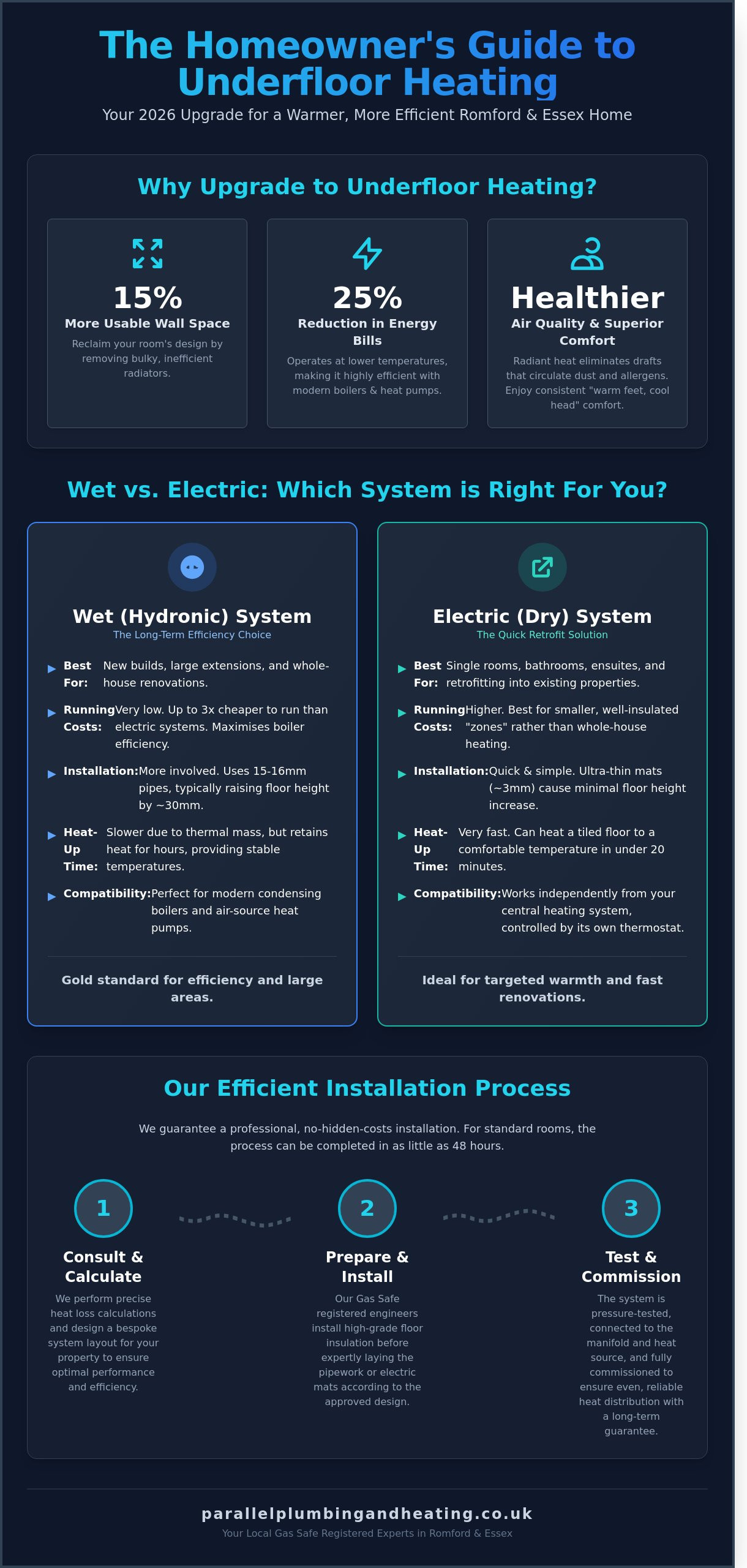
The completely hidden nature of underfloor heating is one of its greatest assets, freeing up as much as 15% of your wall space. For homeowners in smaller London terraces, removing radiators allows for far more flexible and creative furniture layouts. This aesthetic advantage is particularly powerful in modern bathroom renovations, where clean lines and uncluttered walls are highly desirable. The same principle applies to traditional bathroom designs, where period features like freestanding cast iron tubs benefit from the invisible warmth that UFH provides without compromising the authentic aesthetic. For those planning luxury bathrooms in SE London and Essex, underfloor heating is an essential component that elevates both comfort and the overall spa-like experience.
Wet vs. Electric Underfloor Heating: Comparing the Best Systems for Your Property
There are two primary types of underfloor heating: water-based (wet) and electric. The best choice for your home depends largely on the project scope—whether you’re building a new extension, renovating an entire ground floor, or simply updating a single room. It’s also crucial to select a system that is compatible with your current heat source, be it a gas boiler or a modern heat pump. Both systems work exceptionally well with popular Essex floor finishes like stone, tile, and engineered wood.
Wet Underfloor Heating: The Long-Term Efficiency Choice
Wet UFH systems work by circulating warm water through a series of pipes laid beneath the floor, connected directly to your central heating system. While they are more complex and costly to install, especially in existing rooms, their running costs are significantly lower. This makes wet systems the most efficient long-term choice for new-builds, extensions, and major ground-floor renovations across London and Essex.
Electric Underfloor Heating: The Quick Retrofit Solution
Electric UFH uses a network of thin heating mats or cables that are installed just below the final floor surface. Because they have a much lower profile, electric systems are the preferred solution for retrofitting in smaller areas like bathrooms or in upstairs rooms where minimising floor height build-up is a priority. They heat up much faster than wet systems but come with higher running costs, making them ideal for rooms used less frequently.
Calculating the Real Cost and ROI of UFH in 2026
When planning your underfloor heating installation, it’s essential to understand both the initial investment and the long-term return. UFH can be up to 25% more efficient than a radiator-based system, especially when paired with a modern condensing boiler. In the context of 2026 energy prices, this efficiency gain, managed by smart thermostats, translates into significant savings. Furthermore, installing a high-quality UFH system can noticeably increase the market value of your property in competitive areas like London and Essex. For business owners considering heating upgrades for their premises, the same efficiency principles apply to commercial boiler installation in Romford, London & Essex, where modern systems can deliver substantial operational cost savings.
Installation Costs vs. Running Costs
The initial capital outlay for wet and electric systems differs significantly. Wet systems require more extensive floor preparation and plumbing work, leading to a higher installation cost. As a 2026 estimate for the South East, you can expect professionally installed wet systems to cost between £120 and £185 per square metre. However, their low running costs provide a better long-term return. Electric systems are cheaper to install but more expensive to run. An often-overlooked benefit of wet UFH is that its lower flow temperatures put less strain on your boiler, potentially extending its operational lifespan and reducing the need for boiler repair Essex services.
Smart Controls and Energy Savings
To maximise efficiency, a modern UFH system should be paired with multi-zone smart thermostats. These controls allow you to heat only the rooms you are using, drastically reducing wasted energy. Many "self-learning" thermostats can even adapt to the unique thermal properties of your home, optimising heating schedules automatically. This zoning capability means you can have a warm kitchen in the morning without needlessly heating unoccupied bedrooms overnight. For homeowners looking to get the most from their entire climate control setup, understanding the full scope of heating and air conditioning repair in South East London and Essex is essential to ensuring every component of your home’s system operates at peak efficiency.
The Installation Process: What to Expect from Your Essex Heating Engineer
A successful underfloor heating installation is built on meticulous planning and expert execution. The process always begins with a professional heat loss calculation for each room to ensure the system is specified correctly. This is followed by careful floor preparation, which includes laying high-grade insulation to direct all the heat upwards into the room. After the pipes or mats are laid, the system undergoes a critical pressure test to check for any leaks before the final floor screed or surface is applied. The final step is the commissioning and balancing of the manifold, ensuring every part of your home heats up evenly and efficiently.
Floor Suitability and Preparation
The "build-up" height of the system is a key consideration. Different floor constructions and screeds, such as fast-drying liquid screed, can affect both the height and the project timeline. We ensure the system is perfectly suited to your chosen floor finish, whether it’s tile, luxury vinyl tile (LVT), engineered wood, or even certain types of carpet. Our team has extensive experience working with the suspended timber floors and structural joists commonly found in older London properties, including those requiring structural assessments for heavy features like traditional bathroom installations with cast iron tubs. This expertise also extends to high-specification projects, where underfloor heating forms the foundation of a luxury bathroom design and installation that demands both technical precision and premium finishes.
The Importance of Gas Safe Commissioning
Connecting a wet underfloor heating system to a gas boiler is work that, by law, must be completed by a Gas Safe registered engineer. This is not just a regulatory requirement; it is a critical safety measure. At the end of the installation, our engineer will conduct a full handover, showing you exactly how to use your new controls for maximum comfort and efficiency. Every installation by Parallel Plumbing and Heating is backed by our comprehensive workmanship guarantee for your complete peace of mind.
Expert Underfloor Heating Installation in London and Essex
Choosing the right installer is the most important decision you’ll make. Parallel Plumbing and Heating is the local "safe pair of hands" for underfloor heating installation across London, Essex, and the South East. We pride ourselves on transparent, fixed-price quotes with a strict "no hidden costs" policy. Our goal is to guide you smoothly from your initial enquiry to enjoying the quiet, consistent warmth of your new system.
Why Local Expertise Matters
Our team’s deep familiarity with the region’s housing stock and infrastructure is a significant advantage. For example, we understand how the hard water common in Essex can impact heating components and take preventative measures. Before installing underfloor heating, it’s often beneficial to ensure your existing central heating system is operating at peak efficiency with a professional power flush to remove sludge and debris that could compromise the performance of your new UFH system. As reliable local plumbers, we are always available for post-installation support and offer 24/7 emergency availability, providing a level of reassurance that national firms simply cannot match.
Start Your Project with Parallel Plumbing and Heating
Ready to transform your home’s comfort and efficiency? Our expertise isn’t limited to UFH; we are specialists in boilers, bathrooms, and all aspects of domestic heating. The first step is a professional site survey where we can assess your property and provide a detailed, accurate quote.
Get your fixed-price underfloor heating quote today.
Frequently Asked Questions
How much does underfloor heating installation cost in London & Essex in 2026?
For wet systems, a professional installation typically costs between £120 and £185 per square metre. Electric systems have a lower installation cost but higher running costs. A site survey is needed for a precise, fixed-price quote.
Can I install underfloor heating under my existing floor?
Retrofitting is possible, especially with low-profile electric systems. For wet systems, it usually requires removing the existing floor, making it more suitable for major renovations.
Is wet underfloor heating better than electric for a large extension?
Yes. For large areas and primary living spaces, a wet system’s lower running costs make it a much more economical and efficient long-term solution.
How long does it take to install underfloor heating in a standard room?
Installation of the system itself can take 1-2 days, but you must also factor in time for the screed to dry, which can take several weeks depending on the type used.
Do I need a new boiler to have underfloor heating installed?
Not necessarily. Most modern condensing boilers are compatible with UFH. We will assess your current boiler’s capacity and condition during the site survey.
What is the best flooring for underfloor heating efficiency?
Hard, dense materials like stone, ceramic tile, and slate are the best conductors of heat. Luxury Vinyl Tile (LVT) and engineered wood are also excellent choices.
Can underfloor heating replace radiators completely in an older Essex home?
Yes, in most cases. A properly designed and installed UFH system, based on a thorough heat loss calculation, can provide all the heat your home requires, allowing you to remove all radiators.
Is underfloor heating expensive to run compared to traditional heating?
No. When installed correctly, wet underfloor heating is up to 25% more efficient to run than radiators because it operates at a lower water temperature.