

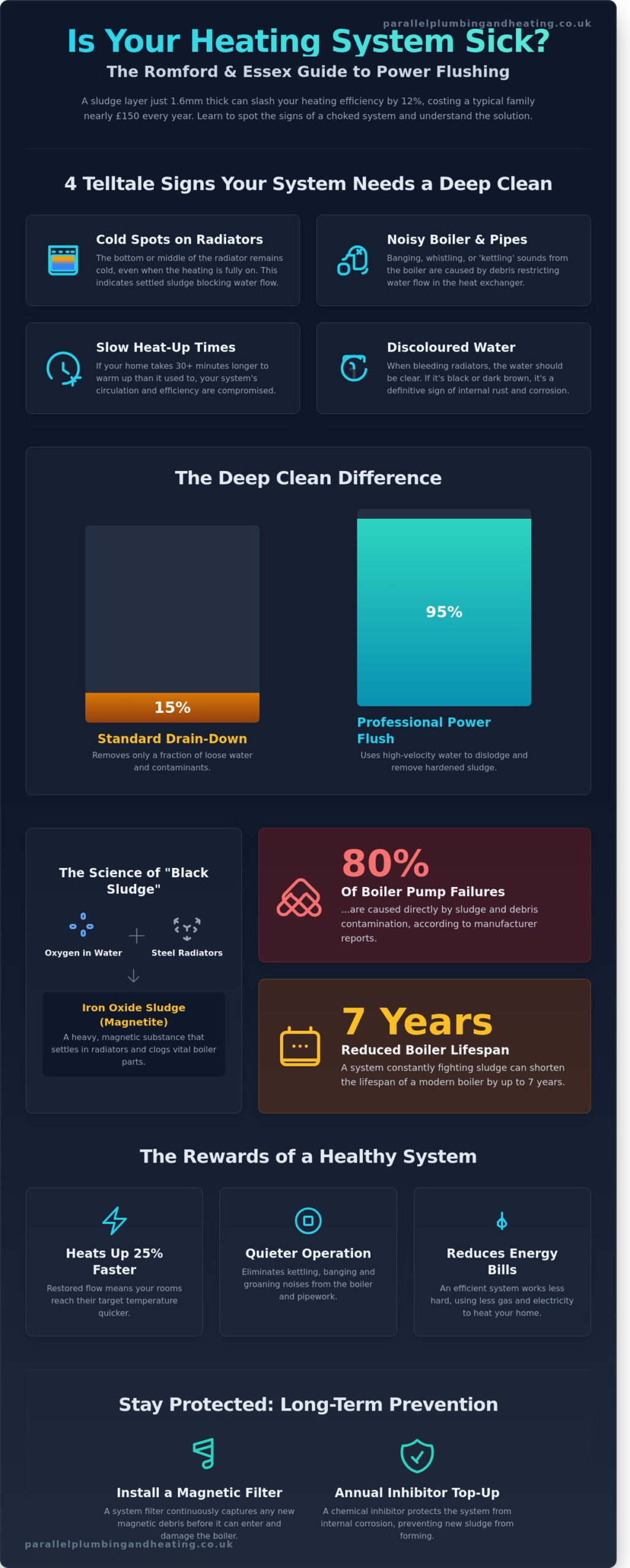
Did you know that a layer of sludge just 1.6mm thick inside your central heating system can slash your efficiency by up to 12%? For a typical family home in Romford, that’s equivalent to throwing nearly £150 a year straight into the gutter. If you’ve found yourself cranking up the thermostat only to be met with lukewarm radiators and a noisy, kettling boiler, you aren’t alone. These aren’t just minor annoyances; they’re the primary symptoms of a system choked by black iron oxide. Professional power flushing radiators is the most effective way to clear this debris and get your heating back to peak performance.
We understand how stressful it is when your home doesn’t feel like a sanctuary, especially with energy prices remaining a top concern for Essex households in 2026. You deserve a heating system that works reliably without making a racket or draining your bank account. This article identifies the specific warning signs of sludge buildup and explains how a professional flush restores heat to every room while protecting your boiler warranty. We’ll cover everything from identifying cold spots to the long term savings you can expect after a visit from a Gas Safe registered engineer.
Key Takeaways
-
Spot the symptoms of "black sludge" contamination, from cold radiator bases to disruptive boiler noises like banging or whistling.
-
Understand why professional power flushing radiators is the superior deep-clean method for restoring heat and reducing energy bills in your Romford home.
-
Evaluate the cost-to-benefit ratio of mechanical flushing versus chemical treatments to ensure your Essex heating system gets the right level of care.
-
Master the long-term prevention strategy by using magnetic filters and annual inhibitor top-ups to keep your pipes clear and your warranty valid.
Table of Contents
-
Why Power Flushing is Essential for Romford and Essex Heating Systems
-
The 7-Point Diagnostic Checklist: Signs You Need Power Flushing Radiators
-
Power Flush vs. Chemical Flush: Choosing the Best Method for Your Home
-
The Professional Power Flushing Process: What to Expect in Essex
-
Long-Term Efficiency: How to Prevent Sludge Returning to Your System
Why Power Flushing is Essential for Romford and Essex Heating Systems
Your heating shouldn’t be a struggle. A power flush is a high-flow, low-pressure deep clean designed to restore your central heating system to its original efficiency. We use specialised pumps and high-strength cleansing chemicals to purge the internal pipework of damaging debris. Many homeowners mistake a standard system drain-down for a deep clean. A gravity-led drain-down typically only removes 15% of system contaminants. In contrast, power flushing radiators uses high-velocity water to dislodge and remove up to 95% of internal sludge. This process is essential for maintaining a healthy home environment and protecting your boiler warranty in 2026.
Parallel Plumbing and Heating Ltd engineers focus on results. We don’t just move the dirt around; we extract it entirely using magnetic filtration during the flush. This ensures your system runs quietly and heats up 25% faster than a sludge-restricted system. By choosing a professional flush, you are investing in the long-term health of your property. It’s a direct solution to the common "cold spot" problem that plagues many Essex households during the winter months.
The Science of Sludge: How Magnetite Ruins Radiators
Internal corrosion is a silent threat. When oxygen in the water reacts with the internal steel surfaces of your radiators, it creates iron oxide. This heavy, black substance is known as magnetite. Because it’s heavier than water, it settles at the bottom of radiator panels. This creates those frustrating cold patches. Magnetite is magnetic, meaning it gets pulled into the boiler’s pump and heat exchanger. Statistics from 2024 boiler manufacturer reports show that 80% of central heating pump failures are caused by sludge. This debris forces your pump to work harder, increasing your electricity bills and shortening the lifespan of your appliance by up to 7 years.
Local Water Quality in Romford and South East London
Romford and the wider Essex region are notorious for hard water. Local supplies often contain over 200mg of calcium carbonate per litre. This mineral content acts as a catalyst for internal corrosion. Limescale builds up inside the pipework, creating a rough surface where magnetite can easily attach and harden. We prioritise power flushing radiators in RM and SE postcodes because these areas experience 30% more scale-related breakdowns than softer water regions. Our team understands the local geology and the specific impact it has on your pipes. We use specific descaling agents tailored for the South East’s water profile to ensure every trace of limescale and sludge is gone. This proactive maintenance prevents the "kettling" noises often heard in local boilers, providing you with a silent and reliable heating system.
The 7-Point Diagnostic Checklist: Signs You Need Power Flushing Radiators
If you live in Romford or the wider Essex area, your central heating system faces significant demand during the damp winter months. Over time, internal corrosion creates a thick, black sludge known as magnetite. This sludge restricts flow and forces your boiler to work harder, often leading to a 15% increase in energy bills before a total breakdown occurs. Identifying these signs early prevents a costly emergency call-out in the middle of January 2026.
-
Cold spots: If the bottom or centre of your radiator remains cold while the top is hot, sludge has settled and blocked the internal channels.
-
Noisy boiler: Kettling, banging, or whistling sounds indicate that debris is trapped in the heat exchanger, causing localized overheating.
-
Discoloured water: When you bleed your radiators, the liquid should be clear. Black or dark brown water is a definitive sign of internal rust.
-
Slow heat-up times: If your home takes 30 minutes longer to reach temperature than it did two years ago, your system’s efficiency is compromised.
As CORGI Trade explains power flushing, these symptoms are progressive. Ignoring them leads to permanent damage to your pump and heat exchanger. Our team can provide a professional system health check to confirm if your installation requires immediate attention.
Diagnostic Step 1: The Radiator Touch Test
Wait for your heating to be on for at least 20 minutes before testing. Safely run your hand across the surface of each panel. A healthy radiator feels uniformly hot. If you notice the top is cold but the bottom is hot, you likely have trapped air that needs bleeding. However, if the bottom is stone cold while the top is warm, sludge is the culprit. Always check the radiator furthest from the boiler first. In many Essex semi-detached homes, this is usually the landing or a rear bedroom. If this specific radiator is struggling, your pump is failing to push past internal blockages.
Diagnostic Step 2: Boiler Behaviour and Error Codes
Modern boilers are highly sensitive to flow rates. Sludge causes the system to "cycle," where the boiler fires up and shuts down every few minutes because it cannot move the heat away fast enough. Keep an eye out for specific error codes on your display. On Vaillant models, F22 or F75 often point to circulation issues. On Baxi units, E119 is a common indicator of pressure and flow problems. Frequent pump failures are rarely bad luck; they are almost always caused by the abrasive nature of magnetite. Investing in power flushing radiators now can save you the £500 cost of a secondary heat exchanger replacement later this year.
Power Flush vs. Chemical Flush: Choosing the Best Method for Your Home
Deciding between a chemical flush and a full power flush is a common dilemma for homeowners in Romford. A chemical flush is a passive process. It relies on gravity and your boiler’s existing pump to circulate cleaning agents through the pipes. It’s a gentle method, but it lacks the strength to move heavy, settled sludge. In contrast, power flushing radiators involves connecting a high-velocity pump to your system. This machine creates a powerful mechanical flow that dislodges hardened magnetite that a standard pump simply cannot touch.
To understand the technical requirements, industry experts at CORGI Trade provide a detailed breakdown of what is a power flush and how the high-flow, low-pressure approach protects your pipework while scouring it clean. For a typical 3-bedroom semi-detached home in Essex, a power flush usually costs between £450 and £600. While this is higher than a basic chemical treatment, the results are far more comprehensive.
When is a Chemical Flush Sufficient?
A chemical flush is best treated as a preventative measure. We recommend this for systems less than five years old that show no signs of cold spots or noisy operation. It’s a standard part of routine maintenance. If your system is healthy, a chemical refresh during your annual boiler servicing in Romford is often enough to keep corrosion at bay. Without the high-velocity agitation of a power flushing machine, however, chemicals alone won’t clear significant blockages in older radiators.
The ROI of a Professional Power Flush
The financial return on a power flush is measurable. By removing sludge, you can see energy bill savings of up to 15% immediately. For a London or Essex property, this translates to roughly £120 to £210 saved per year at 2026 energy rates. Beyond the monthly bills, you’re avoiding the "hidden cost" of a £3,000 emergency boiler replacement. A clean system runs cooler and more efficiently; this reduces the carbon footprint of your home and extends the lifespan of your pump and heat exchanger by up to 10 years.
Before booking, consider these vital factors for your property:
-
New Boiler Requirements: If you’re installing a new energy-efficient boiler in 2026, a power flush is mandatory. Most manufacturers, including Worcester Bosch and Vaillant, will void your warranty if the new unit is connected to a dirty, sludge-filled system.
-
System Age Risks: If your heating system is over 25 years old and has visible external corrosion, a power flush might be too risky. The pressure could find weak points in thin radiator walls. In these specific cases, we often recommend replacing the most affected radiators instead.
-
Efficiency Gains: Power flushing radiators can restore heat to rooms that have been 20% colder than the rest of the house for years.
Our team provides transparent, fixed-price quotes with no hidden costs. We ensure your system is handled by a Gas Safe registered engineer who understands the specific plumbing layouts common in Romford’s Victorian terraces and modern Essex developments alike.
The Professional Power Flushing Process: What to Expect in Essex
Parallel Plumbing and Heating Ltd follows a strict multi-stage protocol to restore your heating system to peak efficiency. We don’t guess about the health of your pipes. Our engineers start with a water sample turbidity test. This provides a scientific measurement of suspended solids in your system. If your reading exceeds 100 NTU (Nephelometric Turbidity Units), your system is officially contaminated and requires a deep clean. We then connect our specialised high-flow pumping station to your circuit, usually at the central heating pump or a primary radiator. This creates a high-velocity, low-pressure flow that shifts debris without risking pipework damage.
The core of the process involves individual radiator agitation. We use specialised tools like vibro-cleaners to vibrate the radiator surface, dislodging stubborn magnetite that has settled at the bottom. Once the water runs clear in every zone, we neutralise the system. We add high-quality chemical inhibitors, such as Sentinel X100, to provide long-term protection against future corrosion. This ensures power flushing radiators isn’t just a temporary fix but a long-term investment in your home’s infrastructure.
Preparing Your Home for the Visit
A thorough power flush is a detailed procedure. It typically takes 6 to 10 hours for a standard 3-bedroom semi-detached home in Romford. Our engineers need access to every radiator in the property, so it’s helpful to clear any furniture blocking these areas before we arrive. We take our tidy job policy seriously. We use heavy-duty floor protectors in every work area and wear boot covers to keep your carpets spotless. We leave your home exactly as we found it, just much warmer.
Verification and Water Testing
We believe in transparency. During the process, we use magnetic filters to capture the sludge and show you exactly what was clogging your system. You’ll see the black magnetite for yourself. After the final flush, we perform a pH test to confirm the water is neutral, typically between pH 7 and 8. This ensures no acidic cleaning chemicals remain to damage your boiler’s heat exchanger. Finally, we issue a formal certificate of completion. This document is essential for 2026 boiler warranty compliance and serves as proof of maintenance for future home buyers.
If your heating system is slow to warm up, book your professional power flush with our local Romford experts to restore your home’s efficiency.
Long-Term Efficiency: How to Prevent Sludge Returning to Your System
You’ve invested in power flushing radiators to restore your home’s warmth; now you need a strategy to keep that efficiency peak. Sludge is a persistent enemy. It begins to reform the moment fresh water enters your central heating pipes. Without proactive maintenance, the benefits of your 2026 flush could fade within just a few seasons. Maintaining a clean system isn’t just about comfort; it’s about protecting your boiler’s internal components from premature failure.
Chemical inhibitors are your first line of internal defence. Products like Sentinel X100 or Fernox F1 create a protective film over the metal surfaces inside your radiators. This barrier stops the chemical reaction between water, oxygen, and steel that creates magnetite. We recommend an annual inhibitor top-up during your service to ensure these levels remain effective. If you notice your system pressure dropping frequently, you might be losing these vital chemicals through a slow leak. Addressing these issues immediately via a professional boiler repair in Essex prevents fresh, oxygenated water from entering the system and restarting the corrosion cycle.
Installing a Magnetic System Filter
A magnetic filter is a mandatory addition for any modern heating setup. Devices like the Adey Magnaclean Professional2 use a high-strength neodymium magnet to capture 98% of circulating iron oxide debris before it reaches your boiler. In Romford and the wider Essex area, where hard water can exacerbate system scaling, these filters are essential. Our engineers can clean the internal sleeve in under five minutes during your annual safety check, showing you exactly how much debris has been diverted from your boiler’s heat exchanger.
The Parallel Plumbing Guarantee
We provide a 3-year workmanship guarantee for all our Romford and London clients. This isn’t just a promise; it’s a commitment to the high standards we set for every job. A professional power flush is often a prerequisite for maintaining your manufacturer warranty with brands like Worcester Bosch or Vaillant. If your system isn’t cleaned to British Standards (BS 7593:2019), these manufacturers may refuse to honour parts replacements for heat exchangers or pumps.
Our Gas Safe registered engineers ensure every radiator is balanced and every zone is running at maximum output before we leave your property. We provide a certificate of completion that serves as proof of maintenance for your records and your boiler’s warranty. Don’t wait for a total system breakdown to take action. You can book a power flush assessment today to secure your home’s heating for the years ahead.
Protect Your Romford Home and Lower Your Bills
Maintaining a high-performing heating system in Essex requires proactive care. Removing iron oxide sludge through power flushing radiators can increase your boiler’s efficiency by up to 25%. This process doesn’t just clear blockages; it protects your internal components from premature failure. You’ll see the results in lower monthly energy bills and a more consistent temperature across every room in your house.
Parallel Plumbing and Heating Ltd provides a reliable, local solution for homeowners. Our Gas Safe Registered engineers deliver fixed-price quotes with no hidden costs, so you know exactly what you’re paying before we start. We stand by our high standards with an industry-leading 3-year workmanship guarantee on every job we complete. Don’t let a sluggish system leave you in the cold during the 2026 winter season.
Restore your heating efficiency: Book a Power Flush in Romford today
Take the first step toward a warmer, more efficient home today. Our team is ready to help you get your system back to peak performance and give you total peace of mind.
Frequently Asked Questions
How much does power flushing radiators cost in Romford and Essex?
A professional service for power flushing radiators in Romford typically costs between £400 and £650 for a standard three-bedroom semi-detached home. This price fluctuates based on the total number of radiators and the current level of sludge buildup in your system. We provide fixed, transparent quotes with no hidden costs to ensure you know exactly what you’re paying before work begins. Our Gas Safe registered engineers provide a full breakdown of costs during the initial site visit.
Will a power flush cause my old radiators to leak?
A power flush won’t cause leaks in healthy radiators, but it can reveal existing corrosion that sludge was previously masking. If your radiators have "pinhole" leaks caused by internal rust, the high-pressure cleaning process will clear the debris that was plugging those holes. Our team conducts a thorough visual inspection of your pipework and 15mm copper tails before starting. We’ll always advise you if your radiators are too degraded to withstand the 1.5 bar pressure used during the process.
How long does a professional power flush take to complete?
A comprehensive power flush usually takes between five and eight hours to complete for a standard residential property. A system with 10 radiators typically requires a full working day to ensure every individual circuit is cleaned until the water runs clear. We don’t take shortcuts because rushing the process leaves behind magnetite that can quickly re-clog your heat exchanger. Our engineers stay on-site until we’ve tested the pH levels and added the necessary chemical inhibitors to protect your system.
Can I power flush my own radiators as a DIY project?
You shouldn’t attempt a DIY power flush because it requires industrial pumping equipment and specialist chemicals that can cause significant damage if handled incorrectly. Professional machines circulate water at speeds of 150 litres per minute to dislodge stubborn blockages. Without the correct training, you risk flooding your home or causing a pressure surge that ruptures your boiler’s internal seals. Hiring a professional ensures the job is done safely and maintains your manufacturer warranty.
How often should I have my central heating system power flushed?
You should have your system professionally cleaned every five to ten years to maintain peak efficiency. In Essex, where hard water can accelerate internal scaling, some systems may require attention sooner if you notice cold spots or a noisy pump. Regular maintenance prevents the buildup of black iron oxide sludge, which is responsible for 80% of central heating breakdowns. Keeping your system clean can extend the lifespan of your boiler by up to 25%.
Is a power flush necessary if I am getting a new boiler installed?
Yes, power flushing radiators is a mandatory requirement for most new boiler installations to validate the manufacturer’s 10-year warranty. Leading brands like Worcester Bosch and Vaillant won’t honour guarantees if a new unit is damaged by debris from old pipework. If you connect a modern, high-efficiency boiler to a dirty system, the narrow waterways in the new heat exchanger will block within weeks. We include a system cleanse with every installation to protect your investment from day one.
What is the difference between a power flush and a system flush?
The main difference is the equipment used, as a power flush uses a dedicated external pump while a system flush relies on the boiler’s own internal pump. A power flush is a much more intensive clean, using high-velocity water to remove 95% of internal sludge and debris. A standard system flush, or "chemical wash," is a passive process that often fails to move heavy magnetite deposits. For systems older than 15 years, a full power flush is the only way to restore original heat output.
Will power flushing make my house warmer and my bills cheaper?
Power flushing radiators will make your home significantly warmer and can reduce your annual energy bills by up to 15%. Removing the internal sludge allows hot water to circulate freely, meaning your rooms will heat up 30% faster than before the service. Your boiler won’t have to work as hard or run for as long to reach your thermostat’s target temperature. It’s a direct, effective way to improve your home’s energy rating while lowering your monthly utility costs.