
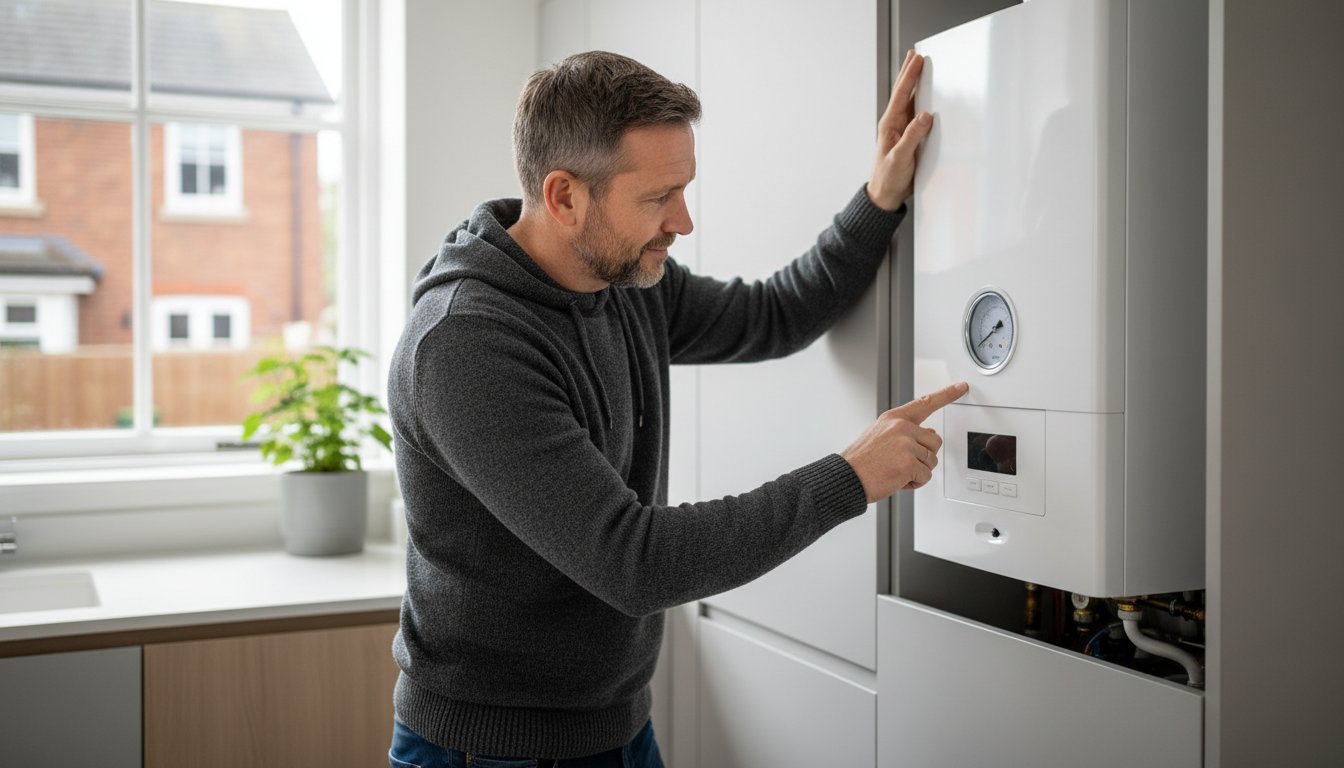
Hot water failure in your home is rarely a random event; it is usually the predictable result of hard water buildup or a simple pressure loss that you can diagnose in five minutes. Waking up to a freezing shower is a stressful way to start any morning, especially when you’re worried about the cost of an emergency repair. Most cases of having no hot water in house Essex properties don’t require a total system overhaul. You likely feel frustrated and uncertain about whether you need a professional or if there’s a simple fix you’re missing.
We’ll show you exactly how to troubleshoot your system to restore your hot water immediately. You don’t need to be a technical expert to perform these basic safety checks. This guide explains the difference between a DIY fix and a situation that requires a Gas Safe registered engineer in Romford or the wider Essex area. With one in six UK homes currently containing an unsafe gas appliance, knowing when to call a professional is about more than just comfort; it’s about your safety. We’ll walk you through the 2026 standards and help you find a reliable local expert who values transparency and high standards of workmanship.
Key Takeaways
- Start with a simple check of your fuse box and cold water supply to rule out external utility issues or tripped circuits.
- Check your boiler pressure gauge; most systems require between 1.0 and 1.5 bar to fire up and provide hot water.
- Discover how to troubleshoot common mechanical faults like diverter valve issues when there is no hot water in house Essex homes.
- Use your immersion heater as a temporary backup and learn when it’s critical to shut off your water stopcock to prevent property damage.
- Access 24/7 support from Gas Safe engineers in Romford with clear, upfront pricing for all emergency plumbing repairs.
Immediate Checks: Why You Might Have No Hot Water Right Now
Facing no hot water in house essex can feel like a disaster. Before you assume the worst, perform these essential checks. Most issues stem from simple supply problems or minor electrical trips rather than a total boiler failure. Start with your cold water supply. If your cold taps are also dry, the issue is likely a local water main failure rather than an internal plumbing fault. This simple distinction determines whether you need to call a utility provider or an engineer.
Distinguishing Between Supply Issues and Boiler Failure
Check multiple taps throughout your home to isolate the problem. If the cold water is running normally in the kitchen and bathroom, your main supply is fine. This confirms the issue lies within your heating system. Visit the Essex & Suffolk Water website or check their social media channels for local supply incident reports. A total lack of water to all taps often points to a burst main in your street or a closed external stopcock. If the cold water flows but the hot water doesn’t, you’ve narrowed the fault down to your boiler or hot water cylinder.
The “Five-Minute Diagnostic” for Homeowners
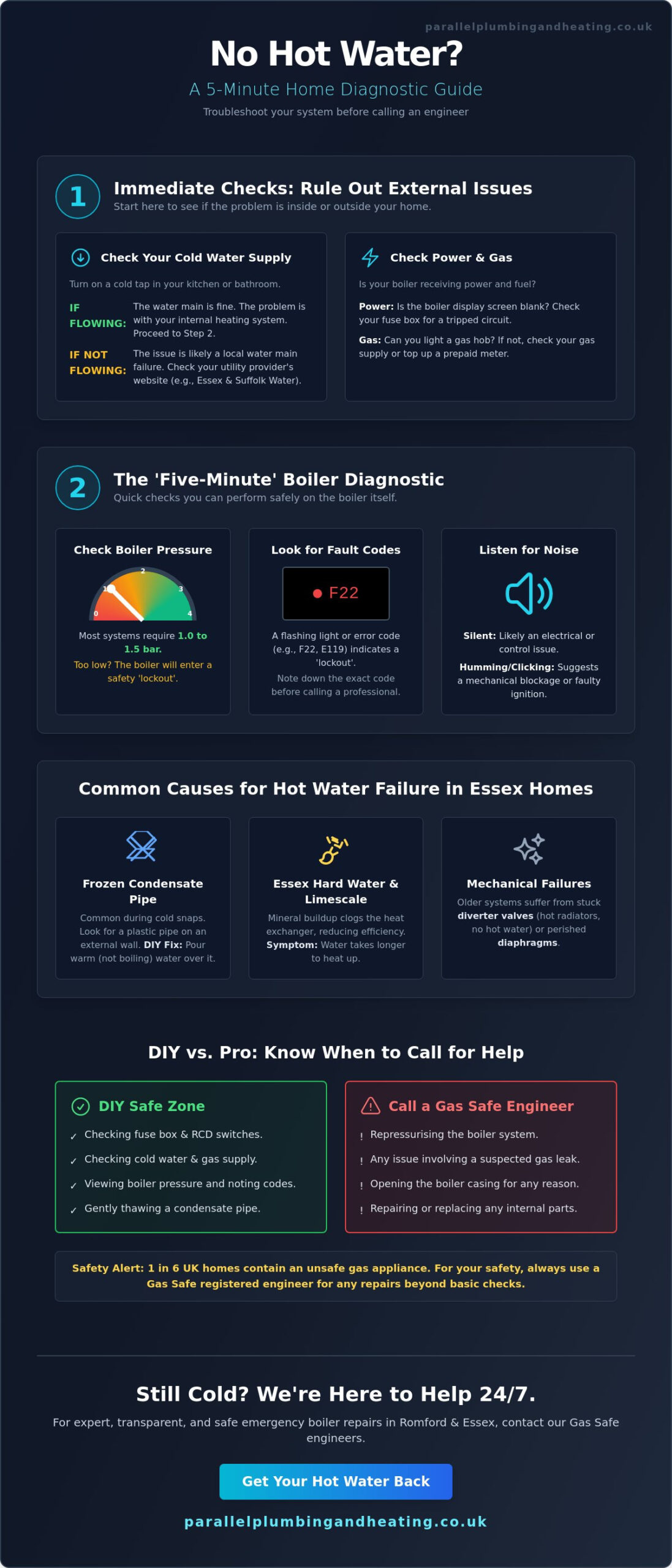
Follow these rapid steps to identify the problem before calling an engineer. These checks save time and could prevent an unnecessary call-out fee. Most homeowners can perform these safely without any specialized tools.
- Check the power: Look at your boiler display screen. If it’s blank, your boiler has no electricity. Check your consumer unit for a tripped fuse or a flipped RCD switch.
- Verify the gas: If you have a gas hob, try lighting it. If the flame is weak or won’t light, you have a gas supply issue. For those with prepaid meters, ensure you haven’t run out of credit.
- Identify a lockout: Look for a flashing red light or a specific fault code on the screen. Codes like F22 or E119 typically indicate low water pressure, while others might suggest a pilot light failure.
- Listen for noise: A silent boiler often suggests an electrical or control issue. A boiler that hums or clicks but doesn’t fire may have a mechanical blockage or a faulty ignition.
Identifying a “lockout” state is critical. This is a safety feature that shuts the system down to prevent damage. If your boiler has locked out, don’t try to force it to restart repeatedly. Note down the exact code displayed. This information is vital when you speak to a Gas Safe engineer; it helps them prepare the right tools and parts for your repair immediately.
Common Causes for Hot Water Failure in Essex and London Homes
Identifying why there is no hot water in house essex properties often comes down to four major culprits. First, check your pressure gauge. Most modern boilers require between 1.0 and 1.5 bar to operate safely. If the needle drops below this level, the system enters a safety lockout to prevent overheating. Second, consider the time of year. During a cold snap, condensate pipes on external walls can freeze, causing the boiler to shut down instantly. Pouring warm water over the pipe often resolves this without a call-out. If these aren’t the issue, the problem is likely internal.
The Impact of Essex Hard Water on Your Boiler
The South East of England has some of the highest concentrations of minerals in its water supply. This hard water creates a significant problem for your heat exchanger. Limescale deposits build up inside the component, acting as an insulator that prevents efficient heat transfer. This forces your boiler to work harder and can eventually lead to a complete failure. If you notice your water takes longer to heat up than usual, a power flush can clear these deposits and restore system performance. Regular maintenance is the only way to combat the aggressive mineral content found in our local supply.
Mechanical Failures: Diverter Valves and Diaphragms
In a combi boiler, the diverter valve is a critical gatekeeper. It directs hot water to either your taps or your radiators. If the valve gets stuck in the “central heating only” position, you’ll have warm radiators but a freezing shower. This is a common mechanical failure in older systems across Romford. You can often diagnose this by checking if the hot water works when the heating is turned off.
Older boilers also rely on rubber diaphragms to sense water flow. Over time, these rubber parts perish or tear due to constant use. When they fail, the boiler doesn’t “know” you’ve turned on a tap, so it never fires up. Mechanical issues like these require a qualified engineer to open the casing and replace the faulty component. If your system is showing signs of age, it might be time to speak with a specialist about reliable repair options to ensure your home stays warm and functional throughout the winter months.
While low pressure is a DIY fix, internal mechanical failures are not. One in six UK homes contains an unsafe gas appliance, so never attempt to dismantle your boiler yourself. Always verify that your engineer is on the Gas Safe Register before any work begins on your gas-carrying components.
DIY Fixes vs. Professional Boiler Repair: When is it Safe?
When you have no hot water in house essex properties, the urge to fix it yourself is strong. You want to restore comfort quickly and avoid unnecessary costs. Some tasks are perfectly safe for homeowners to perform. Others are illegal and dangerous. Understanding this boundary is essential for your safety and the longevity of your heating system. Unlike some advice you might find online, bleeding your radiators is rarely the solution for a hot water failure. In fact, bleeding radiators can lower your system pressure further, potentially worsening the problem.
Safe DIY Tasks for Homeowners
If your boiler has locked out due to low pressure, you can often resolve this in minutes. Follow this three-step guide to use your filling loop correctly:
- Locate the loop: Find the silver braided hose underneath your boiler. It usually has two small black taps.
- Open the valves: Turn both taps slowly. You will hear water entering the system. Watch the pressure gauge carefully as the needle rises.
- Close at 1.5 bar: Once the needle reaches 1.5 bar, close both taps tightly. Check that the boiler display has cleared the fault code.
Check your digital programmer and thermostat settings next. Power cuts or battery failures in wireless thermostats often reset timers to factory settings, which might mean your boiler simply isn’t told to turn on. Additionally, perform a visual inspection of your external flue. Ensure no debris, bird nests, or garden plants are obstructing the terminal. If it’s winter, check the white plastic condensate pipe outside. If it feels frozen, pour warm (not boiling) water over the length of the pipe to melt any internal ice blockage.
When You Must Call a Gas Safe Engineer
You must recognize the “Danger Zone” where DIY attempts become a legal and physical risk. It is a legal requirement in the UK that anyone working on gas appliances must be on the Gas Safe Register. Never attempt to remove the boiler casing yourself. This panel forms a critical seal that prevents combustion gases, including carbon monoxide, from entering your home. If you smell gas, see soot marks on the boiler, or notice a yellow flame instead of a crisp blue one, turn off the gas at the meter and call a professional immediately.
Attempting to repair internal components like diverter valves or printed circuit boards (PCBs) without the proper training is a recipe for disaster. A botched repair can lead to much higher costs or even a condemned boiler. Investing in a professional boiler repair in Essex ensures the job is done to current 2026 safety standards. An expert engineer doesn’t just swap parts; they perform essential safety checks and flue gas analysis to confirm your system is running efficiently and safely.
Emergency Steps to Take While Waiting for an Essex Plumber
Once you’ve determined that a professional call-out is necessary, your focus should shift to containment and preparation. Having no hot water in house essex is a major disruption, but taking the right steps now can prevent secondary damage and speed up our arrival. If you noticed a drop in pressure earlier or suspect an internal leak is the cause of your system failure, find your main water stopcock immediately. It’s usually located under the kitchen sink or near the front door. Turning this clockwise shuts off the rising main. This is vital if a failing component is leaking water inside your boiler or airing cupboard.
Using Your Backup Heating Options
Check your airing cupboard for a hot water cylinder. Most traditional systems feature an immersion heater, which is a backup electric element inside the tank. Look for a wall switch, often with a red neon indicator, and turn it on. While this provides a tank of hot water within about an hour, use it sparingly. Immersion heaters use a lot of electricity and can be expensive if left on for several days. If your home has an electric shower, this runs on its own separate circuit and will continue to work even if your boiler has completely failed. It’s a reliable way to stay clean while you wait for the system repair.
Preparing for the Engineer’s Visit
Make the most of the waiting time by gathering the technical details our engineers need. Every boiler has a data plate listing the specific model and a seven-digit GC number. Having this ready when we arrive allows us to check our van stock for the correct parts immediately. Clear any clutter from around the boiler and move any furniture that might block access to the hot water cylinder or airing cupboard. If you have your most recent Landlord Gas Safety Certificate or service history, lay it out on a nearby surface. This documentation provides a helpful roadmap of your appliance’s history and helps us identify recurring faults faster.
Providing a clear workspace and accurate model information ensures we can work with maximum efficiency the moment we arrive. If you need a rapid response from a qualified team, book a repair with Parallel Plumbing and Heating to get your home back to normal today. We prioritize emergency calls across Romford and the surrounding neighborhoods to ensure no one is left without essential services for longer than necessary. Our engineers are ready to act and restore your comfort with professional, reliable workmanship.
How Parallel Plumbing and Heating Restores Your Hot Water in Romford
Parallel Plumbing and Heating understands that having no hot water in house essex is a genuine emergency. We don’t believe in making you wait. Our team provides a 24/7 emergency call-out service across Essex and South East London to ensure you aren’t left in the cold. We take pride in our transparent pricing. Our £160 emergency repair fee is clear and upfront. You won’t face hidden charges or high-pressure sales tactics. Every engineer on our team is Gas Safe registered. We live and work in the same local neighborhoods as you do. This community focus drives our commitment to safety and high standards of workmanship.
Local Expertise in Romford and Surrounding Areas
Our coverage spans Romford, Peckham, Greenwich, and the wider Essex region. Being a local firm means we can reach your doorstep faster than national chains. Our response times for hot water emergencies are among the quickest in the area. We know the local infrastructure and the specific challenges of the South East’s hard water supply. We back our high-quality workmanship with a three-year guarantee. This commitment to standards gives you immediate peace of mind during a stressful home maintenance crisis. We arrive on time, respect your property, and focus on getting the job done right the first time.
Beyond the Quick Fix: Long-Term Hot Water Reliability
Sometimes a quick fix isn’t enough for long-term reliability. If your boiler is over ten years old or suffers from recurring faults, it might be time to upgrade. We can discuss a new boiler installation in Essex to restore your home’s efficiency. This is often the most cost-effective path for systems that have become temperamental or inefficient. We also handle complex repairs that many national firms avoid due to technical difficulty or part sourcing issues. Our engineers have the technical authority to diagnose deep-seated mechanical faults that others might miss.
To prevent future failures, we highly recommend regular boiler servicing. An annual check-up catches minor issues like limescale buildup or worn diaphragms before they cause a total lockout. This proactive approach saves you money and ensures your system remains compliant with current 2026 safety regulations. Don’t wait for your system to fail completely. Contact Parallel Plumbing and Heating for an immediate response today. We are ready to act and get your hot water flowing again.
Get Your Hot Water Flowing Again Today
Restoring comfort to your home doesn’t have to be a long or expensive process. By performing basic pressure checks and identifying boiler fault codes, you can often distinguish between a quick fix and a mechanical failure. Remember that safety is the priority. If your DIY efforts don’t resolve the no hot water in house essex problem, it’s time to step back and let a professional take over. Handling gas appliances requires expert training to keep your household safe and compliant with 2026 regulations.
Our team is ready to act. We provide Gas Safe Registered Engineers and 24/7 emergency availability to ensure you are never left without support. We stand by our high standards with an up to 3-year workmanship guarantee on our repairs. You can trust our transparent pricing and local expertise to get your system back online safely and efficiently. Don’t settle for a cold home when a reliable solution is just a few clicks away.
Restore your hot water today; Book an Emergency Essex Plumber
We are here to provide the peace of mind and reliable service you deserve. Let’s get your heating system back to its best and your home back to its warmest.
Frequently Asked Questions
Why do I have hot water in the shower but not the kitchen tap?
If hot water reaches your shower but not your kitchen, the boiler is functioning correctly. This specific issue usually points to a localized plumbing fault such as an airlock in the pipework or a failed cartridge inside the kitchen mixer tap. It is not a system-wide failure. A plumber can usually clear an airlock or replace the tap internal components to restore flow quickly.
Can low boiler pressure cause no hot water?
Low pressure is one of the most frequent reasons for having no hot water in house essex properties. Most modern boilers require a minimum pressure of 1.0 bar to fire up. If your gauge shows the needle in the red zone or below 0.5 bar, the system will enter a safety lockout. Repressurising the system via the filling loop usually resolves this immediately without needing a part replacement.
How much does it cost for an emergency plumber in Essex?
We charge £160 for emergency plumbing repairs to ensure you have a clear, fixed cost during a stressful situation. While the average UK call-out fee is approximately £110, specialized emergency services across the Essex region typically range from £170 to £220. Our pricing is transparent and designed to provide a professional, Gas Safe solution without the hidden fees often found with national firms.
Is it safe to reset my boiler if I have no hot water?
It is safe to press the reset button once to see if a minor electronic glitch caused the lockout. If the boiler fails to start or locks out again immediately, stop and call an engineer. Repeatedly resetting a boiler can damage the printed circuit board or mask a serious underlying safety issue like a blocked flue or a gas supply fault.
My boiler is making a whistling noise and there is no hot water; what is it?
A whistling or “kettling” noise is usually caused by limescale buildup on the heat exchanger. This is a common problem in Essex due to the high mineral content in the local water supply. The scale restricts water flow, causing the water inside the unit to overheat and turn to steam. This triggers a safety shutdown to prevent the boiler from exploding or melting internal components.
How long does a typical hot water repair take?
Most common repairs are completed within one to two hours once our engineer arrives on site. Simple tasks like repressurising a system or replacing a faulty sensor are very quick. If your repair requires a complex part like a diverter valve or a new fan, it may take three to four hours. We carry a wide selection of common spare parts to maximize the chance of a first-time fix.
Can hard water cause my boiler to stop producing hot water?
Hard water is a leading cause of boiler inefficiency and failure in the South East. Over time, calcium deposits form a thick crust on the heat exchanger which acts as an insulator. This prevents the burner from heating the water effectively and leads to frequent overheating and system lockouts. Regular servicing or a power flush can remove these deposits and restore your hot water supply.
What should I do if I smell gas while checking my boiler?
If you smell gas, you must act immediately to protect your home. Turn off the gas supply at the meter and open all windows and doors to ventilate the area. Do not operate any electrical switches, use a phone inside the property, or light any naked flames. Evacuate the building and call the National Gas Emergency Service on 0800 111999 from a safe distance outside.