
Imagine waking up on a freezing January morning in 2026 only to find your radiators are stone cold and your boiler is flashing a cryptic sequence of letters. It is a stressful situation that immediately sparks worries about expensive repairs or even potential gas leaks. You need ideal boiler fault codes help to figure out if you’re facing a simple pressure tweak or a job for a specialist. Most homeowners assume an error code means their heating system is finished, but usually, it is just your boiler’s way of protecting itself from further damage.
We agree that technical manuals are often confusing and don’t help when your family is shivering. This guide promises to translate that jargon into plain English so you can take control of the situation safely. We will preview the most common faults, show you which ones have a quick DIY fix, and explain exactly when you must call a Gas Safe engineer to keep your home compliant with the latest 2026 safety regulations. By the end of this article, you’ll know how to restore your hot water or when it’s time to bring in a local expert.
Key Takeaways
- Learn the difference between “F” fault codes and “L” lockout codes to understand if your boiler needs a simple reset or immediate professional attention.
- Discover how to resolve common issues like the F1 low-pressure error yourself without waiting for a plumber.
- Identify critical safety lockouts like L1 and L2 that protect your home from overheating and gas supply failures.
- Access model-specific ideal boiler fault codes help for both the Ideal Logic and Ideal Vogue ranges to ensure accurate troubleshooting.
- Know exactly when to stop DIY attempts and call a Gas Safe engineer to prevent costly damage or safety risks.
Understanding Ideal Boiler Fault Codes: Why Your Boiler is Flashing
Your Ideal boiler is a complex piece of engineering. It’s built to keep your home warm and your family safe. When letters and numbers start flashing on the screen, it isn’t a random error. It’s a safety mechanism. This lockout system acts like a circuit breaker for your central heating system. It shuts down the burner to stop internal damage or potential gas leaks before they become dangerous.
Find the display panel to start your troubleshooting. On Ideal Logic models, look at the bottom right of the front casing. Ideal Vogue owners will find a larger, often full-colour screen in the centre. Knowing these codes is the best way to get ideal boiler fault codes help and decide if you can handle the fix yourself. Ideal boilers use two main types of codes to communicate their status:
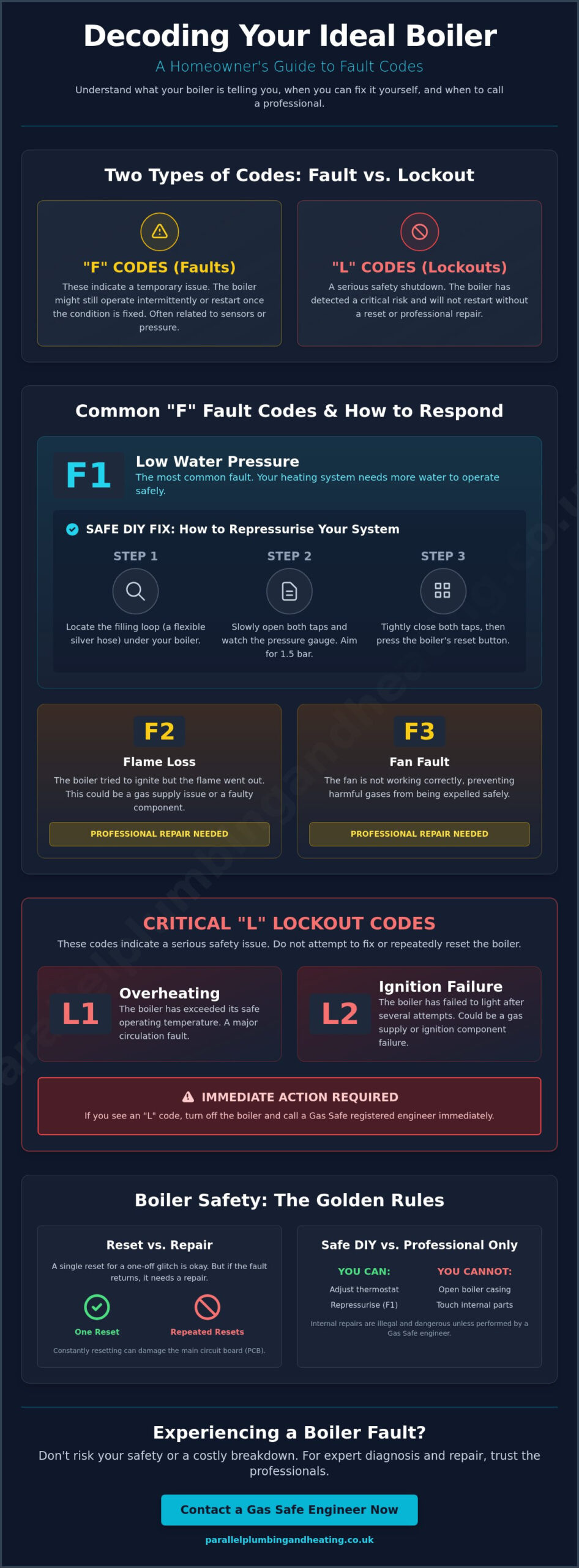
- “F” Codes (Faults): These usually mean the boiler has a temporary problem, like low water pressure. The boiler might still run, or it will restart once the specific condition is met.
- “L” Codes (Lockouts): These are “hard” shutdowns. The boiler has detected a serious safety risk or a major component failure. It won’t fire up again until you reset it or a professional carries out a repair.
Don’t ignore a code that keeps coming back. Even if a reset works for a few hours, a persistent error means a part is failing. Catching a small fault now prevents a full breakdown later. It also saves you from the stress of a cold house and the high costs of emergency call-outs during a winter freeze.
The “Reset vs. Repair” Rule of Thumb
We see many homeowners try to “power cycle” their boiler by turning it off and on repeatedly. Don’t do this. A single reset is fine for a one-off glitch. But if the fault returns within a day, your boiler needs professional help. Constantly resetting a system with a mechanical fault can fry the Printed Circuit Board (PCB). It can also make internal leaks worse by forcing the pump to run when it shouldn’t. If the code returns, you need a repair, not another reset.
Safety First: What You Can and Cannot Touch
You can safely adjust your external controls like the room thermostat or programmer. You can even use the filling loop to top up water pressure if you feel confident. But you must never open the boiler’s front cover or touch internal parts like the gas valve or the fan. The Gas Safe Register is the only legal standard for UK boiler repairs. It ensures that engineers are qualified and follow the latest 2026 safety regulations. DIY internal repairs are illegal and put your home at risk of carbon monoxide leaks. Always prioritize your safety over a quick fix.
Common Ideal “F” Fault Codes: Low Pressure and Sensor Issues
Most homeowners encounter “F” codes first. These are often operational glitches rather than terminal failures. If you see an F1, F2, or F3, your boiler is usually telling you that a specific condition for heating hasn’t been met. Getting ideal boiler fault codes help early prevents a small sensor issue from turning into a total system lockout. In regions like Essex and London, hard water is a frequent culprit. Limescale builds up on internal sensors, particularly the F4 flow thermistor, leading to inaccurate temperature readings and intermittent shutdowns.
The F1 code is the most frequent visitor to Ideal display panels. It signifies low water pressure. Your central heating system is a sealed loop. If the pressure drops too low, the boiler stops firing to prevent the heat exchanger from cracking. While F1 is a DIY fix, codes like F2 (flame loss) or F3 (fan fault) are more complex. An F2 code means the boiler tried to light but failed. This could be a simple gas supply issue, but it often points to a dirty flame sensor or a faulty gas valve that requires a professional touch.
How to Fix an F1 Fault (Low Water Pressure)
You don’t need a toolkit to fix an F1 error. Follow these three steps to restore your heating safely:
- Step 1: Locate the filling loop. This is usually a silver, flexible hose with two small taps underneath the boiler casing.
- Step 2: Open both taps slowly. You will hear water entering the system. Watch the pressure gauge on the front of the boiler or the digital display. Aim for exactly 1.5 bar.
- Step 3: Close both taps tightly. Once the pressure is stable, press the reset button. The F1 code should disappear, and the boiler should fire up.
When F2 or F3 Codes Signal a Part Replacement
If your boiler displays F3, the fan isn’t reaching the correct speed to clear exhaust gases. This is a safety-critical component. The boiler’s Printed Circuit Board (PCB) monitors the fan constantly. If the fan is seized or the PCB fails to send the correct voltage, the system will stay cold. Similarly, persistent F-codes that return after a reset usually mean a sensor has drifted out of its calibrated range. Because these issues involve the gas combustion path or internal electronics, they often require a professional boiler repair to ensure the unit remains safe. If you’ve topped up the pressure and the heat still won’t stay on, it’s time to stop the DIY attempts and consult a specialist.
Before you worry about the cost of a new system, remember that most F-faults are resolved with a simple sensor swap or a system flush. If your boiler is acting up, you can book a fixed-price diagnostic to find the exact cause without the guesswork.
Dealing with “L” Lockout Codes: Ignition and Overheating
L codes are the most serious signals your boiler can send. Unlike the F faults we discussed earlier, these “lockout” codes represent a hard shutdown. The system has detected a high-level safety risk and won’t attempt to fire up again until you manually intervene. Getting ideal boiler fault codes help for L codes is vital because these errors often involve overheating or ignition failure. If your boiler is flashing an L code, it’s protecting itself from expensive internal damage, such as a cracked heat exchanger or a “dry fire” scenario where the unit heats up without enough water circulation.
The most frequent L codes involve circulation issues (L1) or the inability to light the gas burner (L2). You might also see L5 or L6. An L5 code suggests a “false flame” is detected when the boiler should be off, while L6 indicates you’ve tried to reset the boiler too many times without fixing the underlying issue. These codes are safety triggers that prevent the system from becoming a hazard in your home.
L1 Overheating: More Than Just a Hot Boiler
An L1 code means the flow temperature has exceeded safe limits. Your boiler is getting too hot, too fast. This usually happens for two reasons: a failing pump or a major blockage in the pipework. First, check that your radiator valves are actually open. If your Thermostatic Radiator Valves (TRVs) are all turned down, the hot water has nowhere to go, causing an immediate overheat.
If your valves are open but the L1 persists, you likely have a buildup of metallic “sludge” or magnetite. This black debris settles in the heat exchanger and restricts flow. In many cases, a central heating power flush is the only way to clear this debris and stop the L1 lockout for good. Ignoring this leads to a blocked heat exchanger, which is one of the most expensive parts to replace in any Ideal boiler.
L2 Ignition Loss: Fuel and Hardware Checks
When an L2 code appears, your boiler has failed to ignite after several attempts. Before calling an engineer, check your gas supply. If you have a pre-payment meter, ensure you have credit. If your other gas appliances (like a hob) are working, the problem is internal. It could be a worn spark electrode or a dirty ionisation probe that can’t “see” the flame once it lights.
During the cold winter months of 2026, keep an eye on your external condensate pipe. If this plastic pipe freezes, the boiler cannot drain away the acidic runoff from the combustion process. The water backs up into the boiler and prevents ignition, triggering an L2 code. You can often fix this by gently pouring warm (not boiling) water over the external pipe to melt the ice. If the pipe isn’t frozen and you have gas, the fault is likely a mechanical failure within the burner assembly that requires a Gas Safe specialist.
Troubleshooting by Model: Ideal Logic vs. Ideal Vogue Faults
While Ideal uses a standard set of codes across its range, the way you interact with them depends on the specific model on your wall. A flashing code on a ten-year-old Logic looks very different from the full-text diagnostic help on a modern Vogue Gen2. Understanding these hardware nuances is a key part of getting ideal boiler fault codes help that actually works. Whether you have a budget-friendly workhorse or a premium heating system, the display is your first line of communication during a winter breakdown.
If you still have an older Ideal Isar or Icos, you might see “hidden” codes or simple flashing LEDs. These older units don’t have the sophisticated safety sensors found in the 2026 Logic range. If an Isar starts cycling through numbers without firing, it often points to a failing PCB or a blocked heat exchanger. These older models are particularly prone to sludge buildup, making the L1 overheat code a common occurrence as the system ages. Catching these signs early is the best way to avoid a total system failure.
Ideal Logic Series: The Workhorse Faults
The Ideal Logic Series, including the Logic Max and Logic Plus, is the most common boiler found in Romford and Essex homes. These units are highly efficient but incredibly sensitive to system pressure fluctuations. If your system has even a tiny leak in a radiator valve, the Logic will likely trigger an F1 fault faster than other models. For Logic boilers over five years old, we often see wear and tear on the plastic diverter valve components and the fan assembly. Scheduling annual boiler servicing in Romford prevents Logic lockouts by catching these failing parts before they trigger a hard L-code shutdown.
Ideal Vogue: Diagnostic Excellence
The Ideal Vogue Gen2 represents the pinnacle of Ideal’s diagnostic excellence. Instead of just showing a cryptic L2, the Vogue display often provides a full-text description of the problem, such as “Ignition Fault.” This simplifies troubleshooting and helps you decide if you’re facing a simple frozen condensate pipe or a major hardware failure. However, the Vogue’s advanced electronics mean that when a pump or diverter valve fails, the repair requires specialist knowledge. If your Vogue is frequently flashing help messages and is out of warranty, it might be time to compare repair costs against a new boiler installation to ensure long-term reliability and efficiency.
Not sure which model you have or what the flashing light means for your heating? Contact our local Romford team for a fast, fixed-price diagnostic visit to get your home warm again.
Professional Boiler Repair in Romford: When to Call the Experts
When the flashing display won’t clear or the fault returns within hours, you need more than just a manual. You need a Gas Safe specialist who knows these systems inside out. At Parallel Plumbing, we take a transparent approach to every call-out. We offer fixed-price diagnostics so you know exactly where you stand before any work begins. This removes the anxiety of escalating costs during a heating emergency. Our team provides the ideal boiler fault codes help you need when a simple reset isn’t enough to restore your comfort.
Local expertise matters when your house is freezing. Because we are based in Romford, we maintain strong relationships with regional parts suppliers across Essex. This allows us to source genuine Ideal components faster than national firms that rely on central warehouses. We understand the urgency of a total heating failure. That is why we provide a 24/7 emergency call-out service for critical breakdowns. Every repair we carry out comes with a guarantee on our workmanship for up to three years, giving you long-term peace of mind in the reliability of your system.
Local Knowledge: Romford’s Hard Water and Your Boiler
Essex and South East London are notorious for hard water. This high mineral content is a leading cause of premature boiler failure. Over time, limescale settles inside your heat exchanger, leading to the L1 overheating codes we mentioned earlier. Our Romford-based team understands these local plumbing quirks. We don’t just fix the immediate fault; we recommend preventative measures like magnetic filters and scale reducers. These additions protect your investment and ensure your boiler remains efficient throughout the winter months of 2026.
Book Your Ideal Boiler Diagnostic Today
Speed is essential when dealing with a lockout. When you call us, please have your specific fault code ready. This information helps our engineers arrive with the most likely parts required for your specific Ideal model. Our process for emergency boiler repairs in South East London is designed for efficiency. We move quickly from the initial diagnostic to the final repair, ensuring your home is safe and compliant with all current gas regulations. Don’t let a small error code turn into a major system failure. Contact Parallel Plumbing for expert help in Romford and Essex to get your heating and hot water back on track today.
Restore Your Heating and Hot Water Safely
Navigating boiler errors doesn’t have to be a source of winter anxiety. By distinguishing between simple “F” faults and safety-critical “L” lockouts, you can take the right action to protect your home. Whether you’ve successfully topped up your pressure or identified a model-specific display issue, having access to ideal boiler fault codes help ensures you stay in control. Remember that while external controls are safe for you to adjust, internal repairs are a matter of legal safety and professional expertise.
If your boiler remains locked out or the code returns after a reset, our local team is ready to act. We provide Gas Safe Registered Engineers who offer transparent hourly rates and fixed-price quotes, so you never face hidden costs. Every repair we complete is backed by an up to 3-year workmanship guarantee to ensure your long-term peace of mind. Don’t spend another night in a cold house. Book an Emergency Ideal Boiler Repair in Romford & Essex today and let us get your system running at peak efficiency again.
Frequently Asked Questions
Can I fix an Ideal boiler F1 fault code myself?
Yes, you can usually resolve an F1 fault yourself by re-pressurising the system. Locate the silver filling loop underneath the boiler and slowly open the taps until the gauge reaches 1.5 bar. This is one of the few instances where ideal boiler fault codes help doesn’t require a professional call-out. If the pressure drops again quickly, you likely have a leak that needs an engineer’s attention.
Why does my Ideal boiler keep needing to be reset?
A boiler that requires constant resetting has a persistent underlying fault that a simple restart won’t fix. This often points to a failing Printed Circuit Board (PCB) or a sensor that has drifted out of its safe calibration range. Ignoring this puts extra strain on mechanical parts like the pump. If you find yourself resetting the unit daily, it’s time to book a diagnostic visit to prevent a total system failure.
Is an L2 fault code dangerous for my home?
An L2 fault code isn’t immediately dangerous because the boiler has safely locked itself out to prevent gas from flowing without ignition. However, it indicates a serious problem with the gas supply, spark electrode, or flame sensor. While the lockout keeps you safe, you must never attempt to bypass this safety feature. A Gas Safe registered engineer must inspect the burner assembly to ensure the unit operates correctly.
How much does it cost to fix an Ideal boiler fault in Romford?
Repair costs in Romford and Essex vary based on the specific part that has failed and the complexity of the job. While simple sensor swaps are relatively affordable, replacing a major component like a heat exchanger or a fan assembly will be more expensive. We recommend choosing a specialist who offers transparent, fixed-price diagnostic quotes so you know the exact repair cost before any work begins on your system.
What happens if I ignore an overheating (L1) fault code?
Ignoring an L1 overheating code can lead to permanent damage to your boiler’s most expensive internal components. Overheating often results from sludge buildup or a seized pump, which forces the heat exchanger to work under extreme stress. If left unaddressed, this can lead to a cracked heat exchanger or a “dry fire” scenario. Resolving this early with a system flush often prevents the need for a full boiler replacement.
How long does a typical boiler repair take to complete?
Most common Ideal boiler repairs, such as replacing a thermistor, fan, or diverter valve, are completed within one to three hours. Our team carries a wide range of standard Ideal spare parts to ensure we can get your heating back on during the first visit. More complex issues involving extensive pipework or system-wide blockages may take longer, but we always provide a clear timeframe after our initial diagnostic check.
Can a frozen pipe cause my Ideal boiler to show a fault code?
Yes, a frozen external condensate pipe is a very common cause of L2 ignition faults during cold Essex winters. When the acidic runoff from the boiler freezes in the plastic pipe, the water backs up into the unit and prevents the burner from lighting. You can often resolve this safely by pouring warm water over the external pipe. Once the ice melts, a simple reset should restore your heating and hot water.
Does a fault code mean I need a completely new boiler?
A fault code rarely means you need a completely new boiler. Most Ideal Logic and Vogue models are highly modular, meaning individual parts like sensors, pumps, and valves can be replaced easily. Under the 2026 Future Homes Standard, gas boilers are only restricted in new build properties. Homeowners can continue to repair and maintain their existing gas systems for many years to come with the right professional support.