
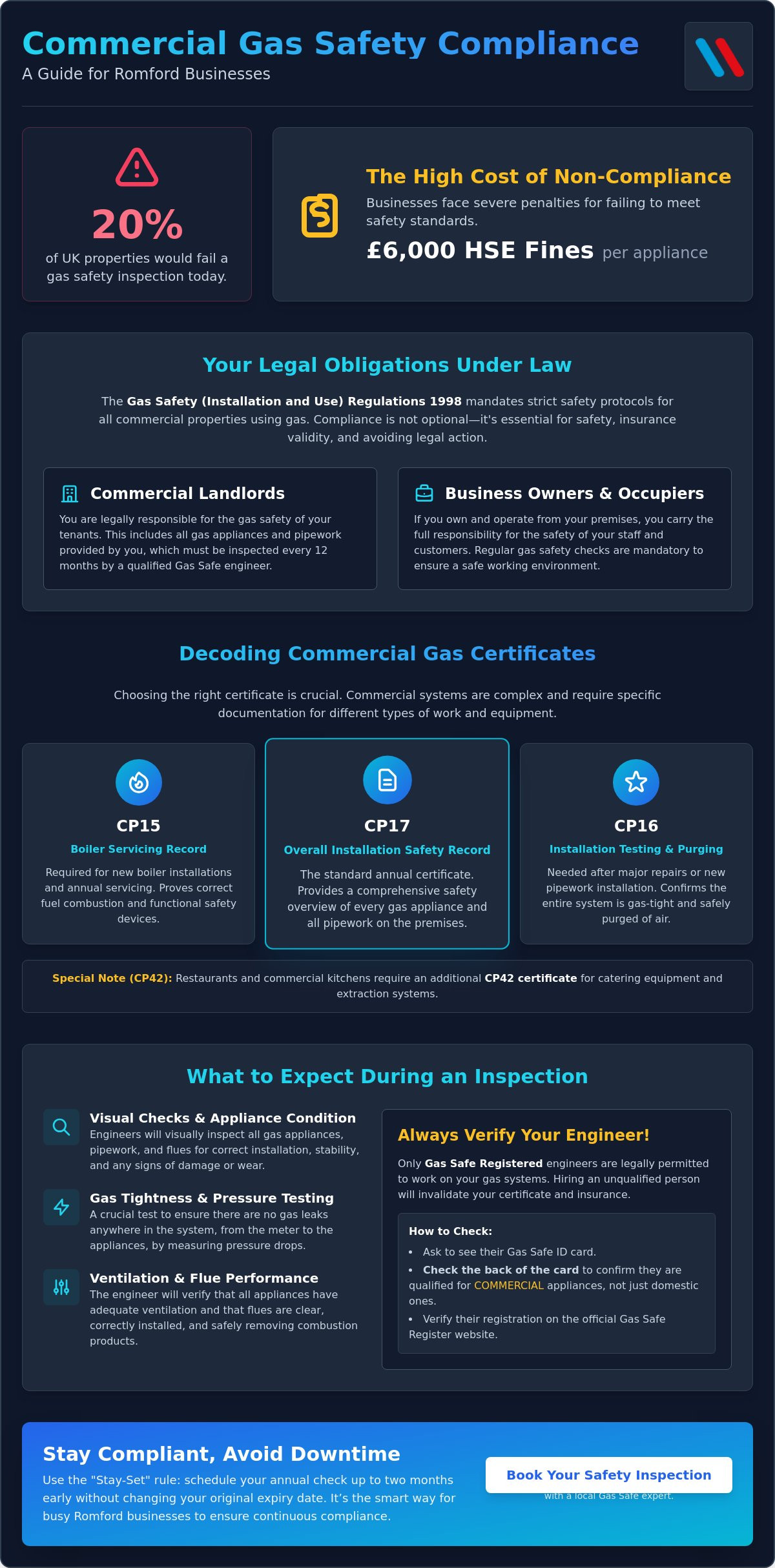
Did you know that 20% of UK properties would fail a gas safety inspection if an engineer walked in today? For a business in Havering, failing to meet these standards isn’t just a safety risk; it’s a financial one that could lead to HSE fines of £6,000 per appliance. Many local owners feel overwhelmed when researching the gas safety certificate cost romford engineers quote, especially when trying to figure out if they need a CP15 for their boiler or a CP17 for the whole system. You want to protect your staff and keep your insurance valid without the headache of complex paperwork.
We understand that business downtime is a major worry during any safety inspection. You need a direct solution that keeps your doors open and your operations legal. This 2026 compliance guide clears up the confusion surrounding commercial gas regulations. We’ll show you how to navigate the latest requirements, maintain a safe environment for your customers, and ensure your Romford premises remain fully compliant with mandatory Gas Safe Register standards.
Key Takeaways
- Understand your legal obligations under the Gas Safety Regulations 1998 to protect your business from heavy HSE fines.
- Learn the specific differences between CP15, CP16, and CP17 records to ensure you book the right inspection for your equipment.
- Navigate the gas safety certificate cost romford businesses face while ensuring your commercial premises remain fully insured and safe.
- Prepare for your inspection by knowing exactly what engineers look for during visual checks and gas tightness testing.
- Discover why using local, Gas Safe registered experts in Romford is the most efficient way to avoid business downtime and stay compliant.
Understanding Commercial Gas Safety Requirements in Romford
A Commercial Gas Safety Record is a mandatory document that confirms all gas appliances and pipework in a non-domestic property meet strict safety standards. You might hear engineers refer to it as a CP17. While domestic landlords use a CP12, commercial settings require a much more rigorous inspection. This is because commercial appliances, like those found in a restaurant kitchen or an industrial warehouse, handle much higher gas volumes and pressures than a standard household setup.
Businesses across Romford must follow the Gas Safety (Installation and Use) Regulations 1998. These rules apply to every commercial entity using gas, from a small retail unit in the RM1 postcode to a large manufacturing plant in RM3. If you’re comparing the gas safety certificate cost romford providers offer, remember that the price reflects the complexity of these commercial-grade systems. A proper inspection ensures your business remains operational and avoids the severe penalties associated with non-compliance.
Local regulation often depends on your building’s specific use and location. For example, a shop in the Liberty Shopping Centre (RM1) has different ventilation and safety requirements than an industrial unit at Gallows Corner (RM3). We understand these regional differences. We also help Romford landlords utilize the “Stay-Set” rule, which allows you to perform your annual check up to two months before the deadline while keeping your original expiry date. This flexibility is a lifesaver for busy local businesses that need to avoid scheduling conflicts during peak seasons.
Who is Legally Required to Hold a Certificate?
The law is clear about who carries the burden of responsibility. If you’re a commercial landlord in Essex, you’re legally responsible for the gas safety of your tenants. This includes ensuring all pipework and appliances are checked every 12 months. Business owners who own and occupy their own premises also fall under these regulations. You’re responsible for the safety of your staff and customers. In mixed-use buildings common in Romford town centre, you need a domestic CP12 for the residential flat and a commercial record for the shop floor below.
The Role of the Gas Safe Register
The Gas Safe Register is the official list of gas businesses which are registered to work safely and legally on gas appliances in the United Kingdom. You should never allow an uncertified person to touch your gas supply. When you check an engineer’s ID card, look at the back to verify their commercial qualifications. An engineer might be qualified for domestic boilers but not for the high-output commercial boilers used in Romford businesses. Hiring someone without the correct commercial registration could invalidate your insurance. It also means your gas safety certificate cost romford investment has been wasted on a document that isn’t legally binding.
Commercial Gas Certificate Types: CP15, CP16, and CP17 Explained
Identifying the specific certificate your business needs is the first step toward full compliance. You shouldn’t have to guess which form applies to your equipment. While the gas safety certificate cost romford engineers charge often depends on the number of appliances, the type of record issued is determined by the work performed. Commercial gas safety isn’t a one size fits all solution. Different documents serve different legal purposes under the official text of the Gas Safety Regulations.
The CP15 is your Commercial Gas Boiler Commissioning and Servicing Record. This document is essential whenever a new boiler is installed or when your existing system undergoes its annual service. It proves the boiler is burning fuel correctly and that all safety devices are functional. If your business relies on a high output heating system, the CP15 is your primary evidence of maintenance.
A CP16 focuses on Commercial Gas Installation Testing and Purging. You’ll need this if you’ve recently extended your gas pipework or after a major repair. It confirms the entire system is gastight and that all air has been safely purged before appliances are ignited. For many Romford businesses, the CP17 is the most familiar document. It acts as the standard Commercial Gas Safety Installation Record, providing a comprehensive overview of every gas appliance on your premises. If you run a local restaurant or commercial kitchen, you’ll also require a CP42, which specifically covers catering equipment and extraction systems.
Choosing the Right Certificate for Your Premises
Your location in Romford often dictates your requirements. A retail unit in the Liberty Shopping Centre might only have a small boiler and a single water heater, requiring a straightforward CP17. In contrast, industrial workshops in RM3 often have complex overhead heaters and production line gas feeds. These sites frequently require multiple certificate types to cover both the installation integrity and the individual appliance safety. Our reliable engineering team can help you identify exactly which combination of records your specific site needs to stay legal.
Frequency and Renewal Cycles
Commercial gas safety records aren’t permanent. You must renew them every 12 months by law. Missing this deadline can lead to immediate HSE intervention and could leave you without insurance coverage. We recommend setting up a planned maintenance schedule at least one month before your current certificate expires. Digital record-keeping has become the standard for Romford property managers in 2026. Storing your CP15 and CP17 records digitally ensures you can produce them instantly during a local authority inspection or when renewing your building insurance.
The Engineering Inspection: What to Expect During the Safety Check
The engineer’s arrival marks the transition from administrative compliance to physical safety. When you consider the gas safety certificate cost romford businesses pay, it covers a highly technical sequence of tests designed to prevent catastrophic failures. A professional inspection begins with a thorough visual assessment. The engineer examines every inch of exposed gas pipework, looking for signs of corrosion, inadequate support, or previous poor workmanship that could compromise the system’s integrity.
Precision is vital during the gas tightness test. This technical procedure involves isolating the gas supply and using a digital manometer to detect even the smallest drop in pressure. If the pressure drops, it indicates a leak that must be located and sealed immediately. All testing procedures align with the HSE’s Approved Code of Practice, ensuring your premises meet the highest national standards. This isn’t just about ticking boxes; it’s about protecting your property and the people inside it.
Combustion safety depends on perfect ventilation. Engineers verify that air vents are unobstructed and that flues are successfully carrying exhaust gases away from the building. They use smoke pellets or electronic analysers to confirm that dangerous carbon monoxide isn’t leaking into your workspace. Finally, they test every safety device, including emergency shut-off valves and flame failure sensors. These components must react instantly in an emergency to cut the gas supply and prevent fire or explosion.
Step-by-Step Walkthrough of the Engineer Visit
Your engineer starts with a briefing to understand your daily operations and identify all gas points. They then move through the building to perform physical testing on boilers, space heaters, and catering equipment. Each appliance is fired up to check its operating pressure and heat input. Once the inspection is complete, the engineer provides a verbal summary of the findings. In 2026, most Romford businesses receive their documentation via a digital Gas Safety Record, which is emailed directly to the property manager before the engineer leaves the site.
Minimising Business Disruption in Romford
We know that closing your doors for an inspection isn’t an option. For retailers in Romford town centre, scheduling visits during off-peak hours or early mornings helps maintain a normal customer experience. You can speed up the process by ensuring clear access to gas meters, plant rooms, and all appliances before the engineer arrives. If we identify minor issues during the check, we aim to handle on-site repairs immediately. This proactive approach helps you achieve a “Pass” result the first time, avoiding the gas safety certificate cost romford firms might face for a second follow-up visit.
Legal Liabilities and Insurance Risks for Romford Businesses
Neglecting your annual gas inspection creates a massive financial trap that goes far beyond a simple paperwork error. While the initial gas safety certificate cost romford engineers charge is a standard business expense, the cost of non-compliance can be ruinous. The Health and Safety Executive (HSE) enforces strict standards across the UK. If they discover unsafe appliances on your premises, you could face fines of up to £6,000 for every single appliance that fails to meet the legal requirements. In cases of severe negligence, these fines can become unlimited and lead to criminal prosecution.
Operational disruption is another major risk. If an engineer identifies an “Immediately Dangerous” situation, they’re legally bound to disconnect your gas supply. For a restaurant in the town centre or a production facility in RM3, this forced downtime stops your revenue instantly. You can’t simply turn the gas back on yourself; you must prove the fault is rectified by a qualified professional. Securing a competitive gas safety certificate cost romford businesses can rely on is a small price to pay compared to the thousands of pounds lost during a forced closure.
Insurance and Gas Safety: A Critical Link
Your commercial building insurance likely contains a clause requiring you to remain compliant with all statutory safety regulations. An expired gas safety record is a direct breach of these terms. If a fire or gas-related incident occurs, your insurer will demand proof of your most recent inspection. If you can’t produce a valid CP15 or CP17, they may refuse to pay the claim entirely. This leaves you personally liable for property damage and third-party injury costs, which could easily bankrupt a local business. Protecting your Romford property investment requires proactive compliance, not reactive repairs. If you need to protect your premises today, you can book your commercial inspection with our local team.
Duty of Care to Employees and Tenants
Under the Health and Safety at Work Act, every Romford employer has a legal duty to ensure a safe environment for staff and visitors. This responsibility is especially high in crowded Romford office blocks or mixed-use buildings where multiple people are at risk. Carbon monoxide (CO) is a primary concern because it’s odourless and tasteless. While commercial CO detectors are essential, they’re no substitute for the technical combustion analysis performed during a safety check. As of May 2026, local authorities in Havering have an increased statutory duty to enforce these regulations. Ensuring your equipment is tested annually is the only way to prove you’ve met your duty of care and kept your workforce safe from harm.
Reliable Gas Safety Certification with Parallel Plumbing in Essex
Secure your business premises with a partner who understands the local landscape. Parallel Plumbing and Heating brings deep regional expertise to every commercial property in the RM postcode. We know that Havering business owners value punctuality and honest communication above all else. Our team consists of fully Gas Safe registered engineers who hold the specific commercial-grade qualifications required for high-output systems. We don’t just provide a document; we provide technical authority and the peace of mind that comes from high standards of workmanship.
We offer a full suite of solutions designed to keep your operations running smoothly. This includes expert landlord gas safety certificates provided at a transparent, fixed price of £120. If your annual inspection reveals a critical fault, our engineers are ready to act. We handle everything from emergency repairs to a complete boiler installation Essex businesses can rely on for long-term efficiency. When you evaluate the gas safety certificate cost romford engineers quote, our commitment to pricing transparency acts as a verbal handshake you can trust.
Our Commitment to Romford Business Owners
We prioritise your schedule to ensure minimal disruption to your daily trade. Our local engineers offer fast response times and flexible booking windows for clients across the town centre and surrounding industrial estates. Following every inspection, we issue detailed digital reports immediately. These records are easy to store and share with your insurers or local authority inspectors. You can view our full range of plumbing and heating services in Romford to see how we support local property managers with comprehensive maintenance packages.
Book Your Commercial Gas Safety Inspection Today
Our booking process is direct and efficient. Whether you manage a single retail unit or a large multi-property portfolio, we provide a streamlined service tailored to your needs. New commercial tenants often feel overwhelmed by compliance requirements. We offer expert advice to help you understand your specific obligations before you even sign a lease. Contact our Romford team today for a bespoke, fixed-price quotation. We take pride in being the dependable local experts who keep Romford’s businesses safe, legal, and fully operational. Our gas safety certificate cost romford service ensures you never have to worry about an expired record or an unsafe appliance again.
Secure Your Romford Business with Expert Gas Safety Compliance
Don’t let an expired certificate put your Romford business at risk. Maintaining a valid CP17 or CP15 record is vital for your building insurance and the safety of your workforce. Compliance goes beyond avoiding heavy HSE fines; it’s about running a professional and safe operation in our local community. You now understand the critical differences between installation testing and annual appliance servicing. You also know why only a Gas Safe registered engineer with commercial-grade qualifications can legally sign off on your business premises.
Securing a fair gas safety certificate cost romford managers can rely on starts with choosing a local specialist. We provide fixed-price certification from £120 to ensure you have complete transparency from the start. Our expert team provides reliable service across Romford and Essex, focusing on high standards of workmanship and clear communication. Let us handle the technical details so you can focus on running your business.
Book Your Romford Commercial Gas Safety Certificate Today and keep your premises protected. We’re ready to help you stay legal and safe.
Frequently Asked Questions
How much does a commercial gas safety certificate cost in Romford?
The price for a commercial inspection depends on the number of gas appliances and the complexity of your pipework. For residential landlord certificates, we provide a fixed price of £120. Commercial rates vary because a warehouse with multiple heaters requires more testing time than a small retail unit. Always request a bespoke quote to understand the specific gas safety certificate cost romford engineers will charge for your unique business premises.
How long is a commercial gas safety certificate valid for?
A commercial gas safety certificate is valid for exactly 12 months from the date of issue. You must renew it annually to remain compliant with UK law. Under the 2018 amendment to the regulations, you can arrange your inspection up to two months before the expiry date while preserving the original deadline. This “Stay-Set” rule allows you to plan ahead without losing any covered time on your current record.
What is the difference between a CP12 and a CP17?
A CP12 is a domestic landlord certificate used for residential rental properties like flats or houses. A CP17 is the equivalent record for commercial properties such as offices, shops, and factories. Commercial certificates involve more complex testing because the appliances often operate at higher pressures. If your building has a mix of residential and commercial units, you’ll likely need both types of documentation to be fully compliant.
Can a Romford business operate without a valid gas safety certificate?
No, operating a business without a valid certificate is a serious legal breach that carries heavy penalties. You risk unlimited fines from the HSE and potential criminal prosecution if an accident occurs. Beyond the legal penalties, your commercial building insurance will likely be invalidated. This means you won’t be covered for fire or gas-related damage, leaving your business assets and property completely unprotected.
Do I need a certificate if I only have one gas appliance in my office?
Yes, you’re legally required to have a certificate even if you only have one gas appliance on the premises. The law applies to any gas equipment used in a workplace, including a single boiler in a staff kitchen or a single heater in a small office. Every appliance must be checked by a Gas Safe registered engineer to ensure it’s burning fuel safely and is properly ventilated to prevent carbon monoxide buildup.
What happens if my Romford premises fails the gas safety inspection?
If your premises fails the inspection, the engineer will issue a warning notice and explain the necessary repairs. For “Immediately Dangerous” faults, the engineer must disconnect the gas supply to ensure the safety of the building. For “At Risk” issues, you’ll be given a specific timeframe to fix the problem. You won’t receive a passing certificate until all faults are rectified and the system is successfully re-tested.
Who is responsible for the gas safety certificate: the landlord or the tenant?
The legal responsibility typically lies with the landlord, but commercial leases often shift this duty to the tenant. In many “Full Repairing and Insuring” (FRI) leases common in Romford, the tenant is responsible for all maintenance and safety compliance. You should check your specific lease agreement to confirm who’s required to arrange and pay for the annual gas safety check.
How long does a commercial gas safety inspection take to complete?
A standard commercial inspection usually takes between one and three hours to complete. This timeframe depends on the size of your property and the number of appliances that need testing. A small shop with one boiler will be much faster than a large restaurant with multiple catering appliances and complex extraction systems. We recommend clearing access to your gas meter and plant room to help the engineer work efficiently.