

Last Tuesday, a homeowner in Romford discovered a terrifying banging sound coming from their kitchen that sounded like a steam engine. It’s a stressful experience that leaves many people fearing a total system failure or an expensive emergency. If you’re searching for a reliable boiler kettling noise fix, you aren’t alone. Roughly 60% of the UK deals with hard water. This is the primary culprit behind these disruptive whistling sounds, especially in areas like London and Essex.
We understand that a noisy boiler is more than just a nuisance. It’s a source of anxiety and rising energy bills that can’t be ignored. You want to know that your heating system is safe and efficient without the constant threat of a breakdown. This guide will show you exactly why your unit is making these sounds and provide the professional steps needed to silence it for good. We’ll cover everything from descaling techniques to the latest 2026 industry advice on maintaining system health and preventing permanent damage.
Key Takeaways
- Understand why restricted water flow turns into steam bubbles, creating that distinctive and alarming whistling sound in your heating system.
- Identify the right boiler kettling noise fix for your specific situation, from simple DIY pressure checks to professional descaling treatments.
- Learn why hard water in regions like Essex and London leads to rapid limescale buildup and how it impacts your boiler’s heat exchanger.
- Discover how a professional Power Flushing service can clear out stubborn sludge and magnetite to restore your system’s efficiency and silence.
- Gain professional advice on maintaining a safe, quiet boiler to avoid the stress of a total system breakdown and rising energy bills.
What is Boiler Kettling and Why is Your System Whistling?
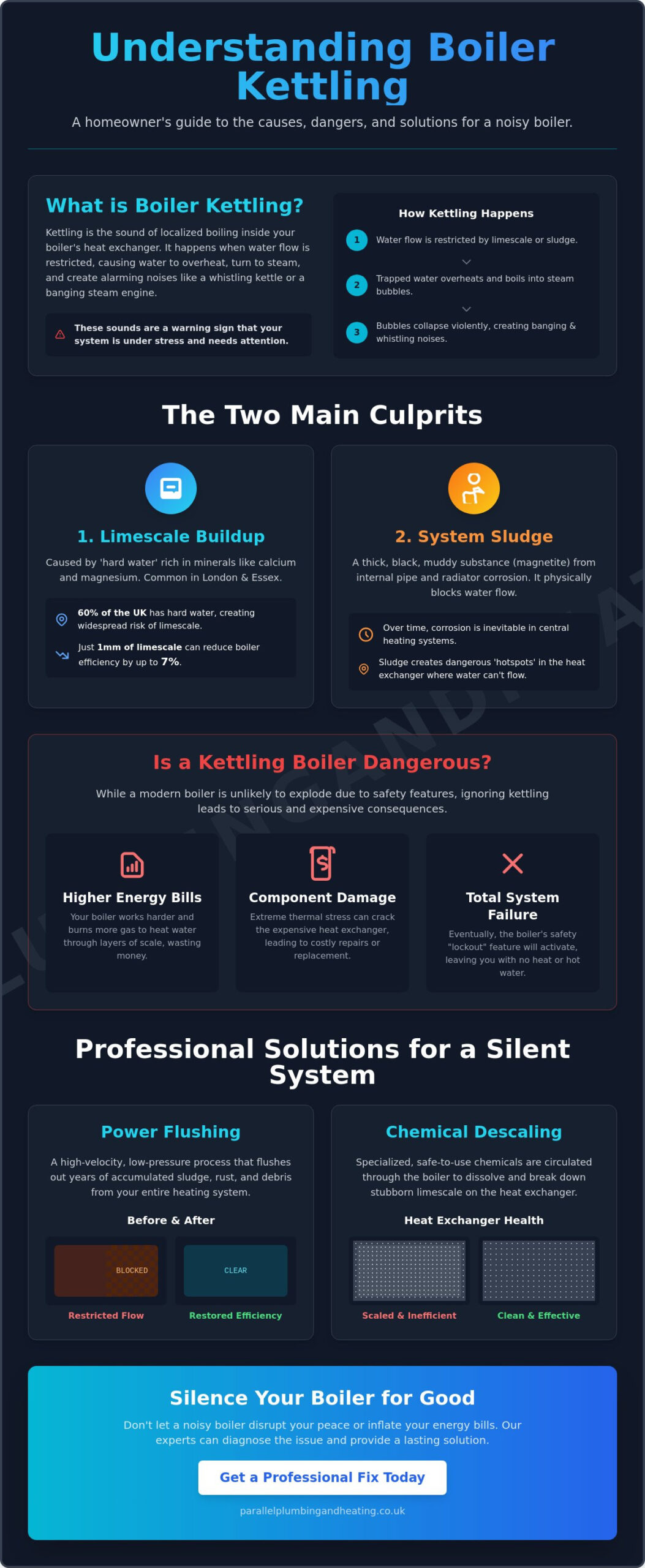
Imagine your morning tea. When the water in your stovetop kettle reaches its boiling point, it whistles. Your central heating system shouldn’t behave this way. Kettling occurs when the flow of water through your unit is restricted, causing the water trapped inside to overheat rapidly and turn into steam. These steam bubbles expand and then collapse violently, creating the alarming noises you’re hearing in your home. Kettling is the sound of localized boiling within the heat exchanger.
When you hear whistling, banging, or deep rumbling vibrations, your system is struggling to breathe. These sounds are the primary indicators that you need a permanent boiler kettling noise fix before the situation worsens. If you ignore these warnings, the internal components face extreme thermal stress. This eventually leads to a total system “lockout,” where the boiler shuts down completely to prevent a catastrophic failure. This leaves you without heat or hot water when you need it most.
Is a Kettling Boiler Dangerous?
Kettling is rarely an immediate explosion risk because modern units feature sophisticated safety valves. However, it indicates high internal pressure and temperature spikes that shouldn’t exist. This localized boiling can cause the cast iron or aluminium heat exchanger to crack over time, leading to internal leaks that are expensive to repair. Beyond physical damage, a noisy boiler is a money-wasting boiler. You’re paying for gas to create useless steam instead of circulating warm water, which causes your monthly energy bills to climb unnecessarily.
Identifying the ‘Kettling’ Sound vs. Other Boiler Noises
It’s vital to distinguish kettling from other common plumbing issues. Whistling is almost always a sign of kettling. Gurgling usually suggests air is trapped in the radiators or the pump. Tapping or clicking is often just the sound of copper pipes expanding as they warm up. To be sure, listen closely to where the noise originates. Kettling starts directly inside the boiler unit. If the banging happens under your floorboards or behind walls, it’s likely pipework expansion or a loose bracket. To understand the complexity of these heating systems, it helps to review What is a Boiler? and how the heat exchanger interacts with your water supply. Pinpointing the source is the first step toward a quiet, safe home.
The Root Causes: Why Boilers in Essex and London Suffer Most
Your location plays a massive role in how your heating system performs over time. Essex and London sit in one of the UK’s most concentrated hard water regions. Approximately 60% of the UK is classified as having hard or very hard water, with levels in the South East often exceeding 200 parts per million (ppm). This mineral-heavy water is the primary reason homeowners in these areas frequently need a permanent boiler kettling noise fix to restore their system’s performance. When minerals stay in your system, they don’t just stay in the water; they settle where they cause the most trouble.
The Limescale Connection in South East London
In areas like Romford and Peckham, the water contains high levels of calcium and magnesium. When this water heats up, these minerals crystallize and “bake” onto the internal surfaces of your heat exchanger. This creates a hard, insulating layer of limescale. It forces the boiler to work harder to heat the water through the thick crust. Industry data confirms that just 1mm of limescale can reduce boiler efficiency by up to 7%. For older boilers, this buildup happens faster, leading to the trapped steam bubbles that cause that distinctive kettling whistle. Installing a simple scale reducer can help protect Essex homes from future mineral damage and keep components clear.
System Sludge and Restricted Flow
Limescale isn’t the only culprit blocking your system’s arteries. Over time, the internal metal components of your radiators and pipes can corrode. This creates a black, muddy substance known as magnetite or “sludge.” This debris settles in the narrow channels of your heat exchanger, creating dangerous hotspots where water cannot flow freely. If your central heating pump is failing, the water won’t move fast enough to carry heat away, causing the stagnant water to boil in place. Maintaining high boiler efficiency and safety requires keeping these pathways clear of debris and ensuring the pump operates at the correct speed.
Faulty thermostats and failing pumps also contribute to the problem. If the internal sensor fails, the boiler won’t know when the water has reached the correct temperature. It continues to fire the burner, leading to overheating and localized boiling. Similarly, a worn-out pump can’t push the water through the system at the required speed. This causes the water to sit against the heat exchanger for too long. If your system is making these alarming sounds, it’s time to act. You can book a professional boiler repair to diagnose the exact cause before a minor blockage turns into a total system failure. This proactive approach ensures your home stays warm and your bills stay manageable throughout the winter months.
DIY Troubleshooting: Safe Checks for Every Homeowner
Before you call out an engineer, there are several safe checks you can perform yourself. While a professional boiler kettling noise fix often requires technical intervention, identifying the symptoms early can save you time and money. Start by checking your system’s pressure gauge, usually located on the front of the boiler or underneath the unit. For most modern systems, the needle should rest between 1 and 1.5 bar when the heating is cold. If the pressure is too low, the water won’t circulate properly, leading to the localized boiling and whistling sounds you’re hearing. Conversely, if the needle is in the red zone, you risk damaging internal seals and valves.
Safety is the absolute priority when dealing with gas appliances. Never attempt to remove the boiler casing or touch any gas-carrying components yourself. This is not just a safety risk; it’s a legal requirement that only Gas Safe registered engineers perform internal repairs. Stick to external checks like inspecting visible pipework for small drips or damp patches. Even a tiny leak can let air into the system, which restricts flow and creates those alarming noises. If you find a leak on a radiator valve, you can try tightening the nut gently, but never force it.
How to Bleed Your Radiators Correctly
Trapped air is a common accomplice to kettling. It creates air pockets that block water from moving through the pipes efficiently. Follow these steps to clear the air safely:
- Turn off your central heating and let the radiators cool down completely.
- Place a cloth or small bowl under the radiator valve to catch drips.
- Use a radiator key to turn the valve anti-clockwise until you hear a hissing sound.
- Once water starts to trickle out, close the valve firmly.
Pay close attention to the water color. If it’s clear, your system is relatively clean. However, if the water is thick, black, or discoloured, this is a clear sign of magnetite sludge. In this case, bleeding is only a temporary patch before a professional boiler kettling noise fix is needed.
Checking and Topping Up Boiler Pressure
If your pressure gauge is below 1 bar, you may need to top it up using the filling loop. This is usually a flexible silver hose with two small valves. Open the valves slowly until you hear water entering the system and watch the gauge rise. Stop immediately once it hits 1.5 bar. Don’t over-pressurise the system, as this puts unnecessary strain on the expansion vessel. If the pressure drops back down immediately after you’ve topped it up, don’t keep adding water. This indicates a leak somewhere in the system that requires a professional diagnostic check.
Professional Solutions: Power Flushing and Descaling
When DIY checks fail to stop the whistling, you need a heavy-duty boiler kettling noise fix. Professional intervention targets the root cause of the blockage rather than just the symptoms. For most homeowners in hard water areas, this involves a deep chemical clean or a mechanical flush to restore the system’s “arteries.” We use specialized descaling chemicals that are specifically formulated to dissolve the “baked-on” calcium and magnesium deposits within your heat exchanger. This process is delicate. It requires precise timing and the correct chemical balance to ensure the minerals are removed without corroding the metal components of your boiler.
Beyond chemicals, we often adjust the burner pressure and internal thermostat settings. If your boiler is “over-firing,” it generates more heat than the water flow can carry away, leading to localized boiling. By recalibrating these settings to match your home’s specific requirements, we ensure optimal flow and thermal efficiency. This technical adjustment often provides the final piece of the puzzle for a silent, reliable system.
What Happens During a Professional Power Flush?
A professional power flush is the most effective way to clear a heavily contaminated system. We connect a high-velocity, low-pressure pumping station to your heating circuit. This machine circulates water and cleaning agents at high speeds to strip away the stubborn magnetite sludge mentioned earlier. We use powerful magnetic filters during the process to catch and remove metallic debris before it can re-enter your boiler. For residents in Romford and across Essex, we recommend this service every 5-6 years to prevent the heavy mineral buildup common in our local water supply.
Repairing vs. Replacing the Heat Exchanger
Sometimes, the damage is too advanced for a clean to be effective. If your heat exchanger is “pitted” or leaking internally, a replacement is the only safe option. This component is the heart of your system, and its integrity is vital for safety. When the cost of a complex repair starts to approach the price of a new unit, we provide an honest cost-benefit analysis to help you decide. Our boiler repair Essex experts can diagnose whether a component swap or a full system upgrade is the most cost-effective long-term solution for your home.
Don’t let a noisy boiler turn into a total system failure. If your heating is banging or whistling, contact our team today for a fixed-price diagnostic visit and a professional solution that lasts.
Stopping the Noise: Parallel Plumbing and Heating Ltd’s Expert Approach
A noisy boiler is a stressful emergency that demands immediate attention. We provide a 24/7 emergency response for homeowners across London and Essex who are dealing with alarming whistling or banging sounds. Our Gas Safe registered engineers understand that you need a permanent boiler kettling noise fix to protect your home and your wallet. We don’t believe in hidden fees or surprise bills. Parallel Plumbing and Heating Ltd offers transparent, fixed-price diagnostics so you know exactly what the repair involves before we start any work. This direct approach removes the guesswork from maintenance and helps you regain control of your home’s comfort.
Our team lives and works in neighborhoods like Romford and Bermondsey. We take pride in our reputation as regional specialists who deliver high standards of workmanship. We stay ahead of the latest industry changes, including the 2026 regulations regarding landlord compliance and safety standards. Our engineers ensure your system meets all mandatory certifications, keeping you on the right side of the law. Whether you’re a homeowner in Romford or a landlord in Bermondsey, we provide the documentation you need for the new national compliance databases. While we can fix most kettling issues through descaling, the best solution is always prevention. Booking an annual boiler service allows us to catch mineral buildup before it restricts flow.
When to Opt for a New Boiler Installation
Repairing an old, inefficient unit isn’t always the smartest financial move. If your boiler is over ten years old and the heat exchanger is heavily corroded, a repair might only be a temporary patch. Modern, high-efficiency boilers are designed to handle hard water environments more effectively than older models. They offer better thermal transfer and lower gas consumption, which helps offset the initial cost through lower monthly bills. Under the Future Homes Standard 2026, existing gas boilers can still be replaced with like-for-like units, ensuring you don’t lose the reliability of a gas system. Explore our boiler installation Essex options to see how a 2026 upgrade could transform your home’s heating efficiency.
The Parallel Plumbing and Heating Ltd Guarantee
We stand behind every job we complete. Our workmanship guarantee lasts for up to three years, giving you total peace of mind that your heating system is in professional hands. We treat your property with respect, ensuring we leave your home clean and your radiators silent. Our goal is to provide a service that feels like a verbal handshake, built on transparency and local trust. Don’t wait for a total system breakdown to occur. Book your boiler repair or service today and let our local experts restore the safety and efficiency of your central heating.
Take Action to Protect Your Heating System Today
Ignoring a noisy boiler only leads to higher energy bills and the risk of a total system lockout. We’ve shown that kettling is often a symptom of limescale or sludge buildup, particularly in our local hard water areas. While basic DIY checks can help you identify the problem, a permanent boiler kettling noise fix requires specialized tools and technical expertise. Acting now prevents minor blockages from turning into expensive heat exchanger failures. You deserve a heating system that operates silently and efficiently throughout the winter months.
The team at Parallel Plumbing and Heating Ltd is ready to restore your peace of mind with fixed-price diagnostics and a 3-year workmanship guarantee. As local experts in Romford and Essex, our Gas Safe Registered Engineers take pride in delivering high standards that keep your home warm and safe. We’re committed to transparency and reliability in every job we do. Silence your boiler today—book a professional repair with Parallel Plumbing and Heating Ltd. Your heating system is the heart of your home; let’s make sure it’s running perfectly and safely for years to come.
Frequently Asked Questions
Is it safe to use a boiler that is kettling?
It is generally safe to use the boiler in the short term, but you should address the issue immediately. Kettling doesn’t mean your boiler will explode, as modern systems have safety relief valves to manage pressure. However, the localized boiling puts immense stress on the heat exchanger. Over time, this stress can lead to metal fatigue and internal leaks, resulting in a much more expensive repair bill later.
How much does it cost to fix a kettling boiler in London?
The cost depends entirely on the underlying cause identified during your diagnostic visit. A minor adjustment or chemical dose is less intensive than a full system restoration or a heat exchanger replacement. London rates vary based on the complexity of the blockage and the parts required for your specific model. We provide transparent, fixed-price quotes for a boiler kettling noise fix after our initial inspection so you know the total cost before any work begins.
Can air in the system cause a kettling noise?
No, air in the system usually creates gurgling, clicking, or radiators that are cold at the top. Kettling is a distinct whistling or banging sound caused by water turning into steam within the heat exchanger. While air can contribute to poor circulation, the “kettle” sound specifically points to flow restrictions caused by limescale or sludge. Bleeding your radiators is a good first step, but it won’t fix true kettling.
Will a power flush definitely stop the kettling noise?
A power flush is the most effective solution if the noise is caused by magnetite sludge or loose debris. It clears the internal blockages that cause water to overheat. However, if the heat exchanger is already “pitted” or heavily scaled with baked-on minerals, a flush might not be enough. In those cases, a professional engineer might recommend a targeted chemical descale or a component replacement to restore silence to your home.
What happens if I ignore the whistling sound in my boiler?
Ignoring the noise leads to decreased efficiency and eventual system failure. As the blockages grow, your boiler has to work harder and burn more gas to reach the target temperature, causing your energy bills to rise. Eventually, the internal sensors will detect the overheating and trigger a “lockout.” This safety shutdown leaves you without any heating or hot water until a professional repair is carried out by an engineer.
How long does a boiler repair for kettling usually take?
A standard diagnostic and minor repair usually takes between one and two hours. If our engineers determine that your system requires a full power flush to clear out years of sludge, the process typically takes five to six hours. We work efficiently to ensure your heating is back up and running as quickly as possible. We always aim to complete the work in a single visit whenever the necessary parts are available.
Is boiler kettling covered by my annual service?
An annual service includes an inspection to identify these issues, but the actual boiler kettling noise fix is considered a restorative repair. During a service, we check the system’s health and look for early signs of scale or sludge. If we find evidence of kettling, we’ll provide a separate quote for the cleaning or descaling required to fix it. Regular servicing remains the best way to catch these problems before they become noisy.
Can I add descaler to my boiler myself?
You shouldn’t attempt to add descaling chemicals to your heating system yourself. Professional-grade descalers are powerful acids that can damage internal seals and pumps if they aren’t used correctly. Our engineers use specialized equipment to circulate these chemicals at the right concentration and temperature. We also ensure the system is thoroughly neutralized and flushed afterward to prevent any ongoing corrosion of your pipework and radiators.