

Imagine waking up on a freezing morning to find your radiators stone cold and the shower running icy. You check the boiler cupboard only to see that the familiar blue flame has vanished. It’s a stressful situation that triggers instant concerns about gas safety and the potential cost of a breakdown. Learning how to fix boiler pilot light out issues is often the first step to restoring your home’s comfort, but you must prioritize safety above all else.
We understand that a failing boiler feels like an emergency, especially when you’re worried about carbon monoxide or a hefty repair bill. This 2026 guide provides the clarity you need during a maintenance crisis. You will learn how to identify why your pilot light keeps failing, from simple draughts to faulty thermocouples. We will walk you through the safe relighting process and, most importantly, explain the clear signs that it’s time to call a Gas Safe registered engineer. Our goal is to get your heating back on quickly while ensuring your household remains protected and your appliance stays compliant with the latest UK safety standards.
Key Takeaways
- Identify whether your appliance uses a permanent flame or electronic ignition to determine the correct troubleshooting path for your model.
- Learn why a faulty thermocouple or soot buildup is often the root cause when you need to fix boiler pilot light out problems.
- Master the safe method for relighting your boiler flame while avoiding common hazards like gas accumulation in the burner chamber.
- Recognize the legal limits of home maintenance and when a professional Gas Safe engineer must take over to ensure your system remains compliant.
- Gain peace of mind by knowing how to spot “rotten egg” odors and other red flags that signal a serious gas emergency.
Understanding Why Your Boiler Pilot Light Has Gone Out
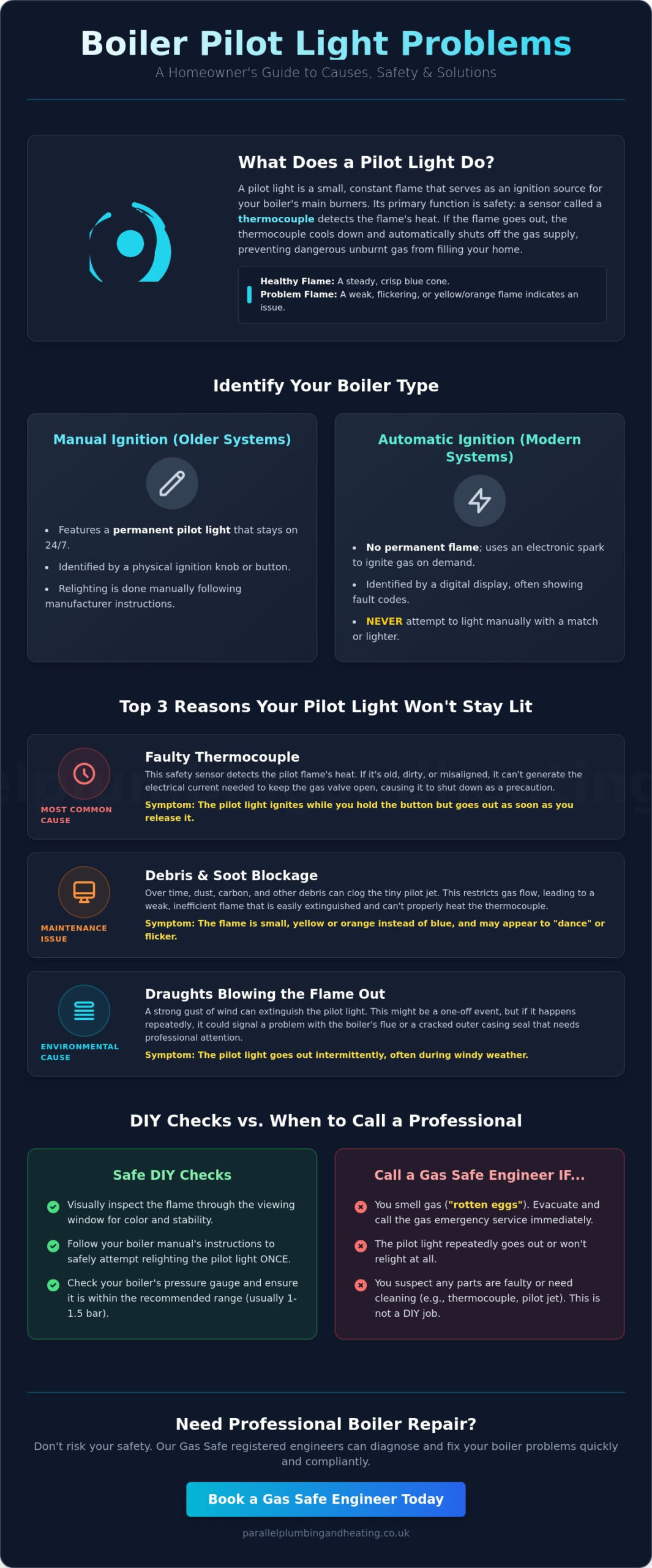
A boiler without a flame is just a cold box of metal. To understand why your heating has failed, you first need to know what is a pilot light and how it functions as a safety guard. This small, standing flame sits inside your appliance, waiting to ignite the main burner whenever your thermostat calls for heat. It acts as a constant ignition source, ensuring that gas burns off safely as soon as it enters the combustion chamber.
Safety is the primary reason this flame exists. If the pilot light vanishes, a safety sensor called a thermocouple detects the loss of heat and immediately shuts the gas valve. This prevents your home from filling with unburnt gas, which is why a pilot light that won’t stay lit is more than just a nuisance; it’s a sign that a safety feature is doing its job. You can usually check the status of this flame by looking through the small glass viewing window located on the front or underside of the boiler casing. If you see a steady blue glow, the pilot is active. If the area is dark, the system has shut down.
Manual vs. Automatic Ignition Systems
The method used to light your boiler depends on its age and technology. Older boilers typically rely on manual ignition. These units often feature a “permanent” pilot light that stays lit 24/7. You can identify these by a physical ignition button that makes a loud “click” when pressed, similar to the spark on a gas hob. In some very old models, there may even be a small port designed for a long match or taper.
Modern combi boilers and high-efficiency systems use automatic electronic ignition. These do not keep a flame burning constantly. Instead, they generate an electric spark only when you turn on a hot tap or the heating kicks in. If you have a modern system and the flame fails to ignite, the boiler will usually display a specific fault code on its digital screen. You must never attempt to manually light an automatic boiler with a match or lighter. These units are sealed for efficiency, and introducing an external flame can damage sensitive electronics or cause a dangerous flash fire.
The Consequences of a Dead Pilot Flame
When the flame goes out, your boiler enters what engineers call a “lockout” mode. This is a total system shutdown that cuts off your central heating and domestic hot water instantly. It’s a protective state designed to keep your family safe from gas leaks. While it might be tempting to simply relight it and move on, a recurring outage suggests a mechanical fault that needs attention. If you find yourself constantly trying to fix boiler pilot light out issues, it’s likely that one of the following problems has occurred:
- Safety Sensor Failure: The thermocouple is worn out and can no longer “see” the flame.
- Blockages: Dust or carbon soot has built up in the pilot jet, making the flame too weak to stay lit.
- Draughts: A problem with the flue or a cracked seal is allowing wind to blow the flame out.
Ignoring these signs can lead to a complete appliance breakdown during the coldest months of the year. A pilot light that flickers or changes from blue to yellow is a clear warning that the combustion process is no longer efficient or safe.
5 Common Reasons Your Boiler Pilot Light Won’t Stay Lit
Identifying why your flame keeps extinguishing is the only way to permanently fix boiler pilot light out issues. While a single outage might be a fluke caused by a sudden draught, a flame that repeatedly vanishes points to a mechanical or environmental failure. You shouldn’t keep relighting a boiler that refuses to stay active, as this often bypasses critical safety protocols designed to protect your home. Most pilot failures stem from one of five specific areas.
The Role of the Thermocouple
The thermocouple is the most frequent culprit behind a failing pilot light. It’s a small, copper rod that sits directly in the path of the flame. This component acts as a heat-sensing safety device. When it’s hot, it generates a tiny electrical current that holds the gas valve open. If the thermocouple is worn out, bent away from the flame, or covered in grime, it won’t produce that current. The boiler then assumes the flame has gone out and shuts off the gas supply as a precaution. If your flame lights while you hold the button but dies the moment you let go, your thermocouple is likely faulty.
Debris and Pilot Jet Blockages
Carbon deposits and dust are silent killers for older heating systems. Over time, soot builds up inside the tiny pilot jet, restricting the flow of gas. You can diagnose this by looking at the flame’s color and shape. A healthy pilot should be a crisp, steady blue cone that makes firm contact with the thermocouple. A “lazy yellow flame” indicates that the gas isn’t mixing with enough oxygen. This weak flame flickers easily and doesn’t produce enough heat to keep the safety sensors engaged. In hard water areas like Romford and across Essex, mineral deposits can indirectly accelerate component wear, leading to increased carbon buildup within the burner assembly that requires professional cleaning.
Beyond these internal parts, other factors can disrupt your system:
- Gas Supply Issues: Ensure your pre-payment meter hasn’t run out of credit and check if other gas appliances, like your hob, are working correctly.
- Draughts and Ventilation: A damaged flue or a missing terminal guard can allow wind to blow directly into the combustion chamber, snuffing out the flame.
- Component Failure: If the thermocouple and jet are clean, the issue may lie with a sticking gas valve or a fault in the boiler’s Printed Circuit Board (PCB).
Historical CPSC safety warnings for pilot lights emphasize that repeated failures are often a precursor to more dangerous malfunctions. If your system requires constant attention, a professional boiler repair can identify the exact component failure before it leads to a total system lockout.
How to Safely Relight a Boiler Pilot Light: Step-by-Step
Before you attempt to fix boiler pilot light out issues, you must perform a thorough safety check. Sniff the air around the appliance and the floor. If you detect a “rotten egg” odor, stop immediately. This scent indicates a gas leak. In this scenario, you should open all windows, evacuate your home, and contact the National Gas Emergency Service. If there is no smell of gas, you can proceed by locating the manufacturer’s lighting instructions. These are typically printed on a sticker inside the boiler’s front panel or on a plastic card tucked into the base of the unit.
Patience is your best safety tool during this process. If your first attempt at relighting fails, you must follow the 15-minute rule. Gas can accumulate inside the combustion chamber during a failed ignition. Waiting at least 15 minutes allows this gas to dissipate safely before you introduce another spark. Ignoring this wait time can lead to a small explosion or “flashback” that could damage the boiler or cause injury.
Relighting Manual Pilot Lights (Older Models)
Older floor-standing or back-boilers require a manual sequence to restore the flame. Start by turning the gas control knob to the “Pilot” or “Star” position. You will need to press and hold this knob down firmly to force gas through to the pilot jet. While the knob is depressed, repeatedly press the piezo igniter button. This is the button that makes a loud clicking sound. Once you see a blue flame through the viewing window, don’t let go of the knob immediately. You must continue holding it for at least 30 seconds. This duration ensures the thermocouple is hot enough to signal the gas valve to stay open. If the flame vanishes the moment you release the knob, the thermocouple is likely faulty or misaligned.
Resetting Modern Automatic Ignition Boilers
Modern combi boilers don’t have a permanent flame to light. They use an electronic spark. If your modern unit has failed, look for a “Reset” button on the front fascia. This is often marked with a flame symbol or a capital “R”. Press and hold this button for five seconds to trigger the ignition sequence. If the boiler fails to fire up after three attempts, do not keep trying. Repeated resetting can stress the internal electronics and suggests a deeper mechanical fault. You should also check the pressure gauge on the front of the boiler. If the needle has dropped below 1.0 bar, the system may be preventing ignition as a safety precaution. Re-pressurizing the system via the filling loop often resolves “no-flame” errors on modern units.
When a DIY Fix Becomes a Safety Risk
Knowing when to stop is the most important part of boiler maintenance. While pressing a reset button or holding a control knob is safe, you must never cross the legal boundary of unscrewing the boiler casing yourself. In the UK, it’s a legal requirement for anyone working on the internal gas-carrying components of a boiler to be on the Gas Safe Register. Attempting to fix boiler pilot light out issues by opening the unit exposes you to high-voltage electronics and pressurized gas lines. If the flame doesn’t stay lit after following the manufacturer’s external instructions, the problem is internal and requires professional diagnostic tools.
Watch for clear warning signs that your appliance is becoming a hazard. Carbon monoxide is a colorless, odorless gas, but your boiler will often show physical symptoms of its presence. Look for sooty black marks around the casing or a pilot flame that burns yellow instead of a sharp blue. If you or your family experience sudden headaches, dizziness, or nausea while the boiler is running, turn the system off immediately. These are not just maintenance issues; they are life-threatening emergencies that no DIY attempt can resolve.
You should also stop all relighting attempts if the pilot light goes out immediately after you release the ignition button. This repeat failure confirms that a safety component, like the thermocouple, has failed completely. Forcing the system to stay on by taping down buttons or bypassing sensors is incredibly dangerous and can lead to a catastrophic fire or gas build-up.
Why You Need a Gas Safe Registered Engineer
The Gas Safe Register serves as the only official list of engineers qualified to work safely and legally on gas appliances. Replacing a thermocouple or a gas valve might look simple in a video, but improper installation can lead to gas leaks or even explosions. A professional boiler repair Essex specialist has the training to test for gas tightness and flue integrity after every fix. This ensures your boiler meets current 2026 safety standards and operates at peak efficiency.
Emergency Procedures for Homeowners
If you smell gas or suspect a leak, act fast. Don’t turn any light switches on or off, as this can create a spark. Locate your gas meter and turn the handle on the pipe to the “off” position, which is usually at a right angle to the pipe. Open every window and door to create a cross-breeze and evacuate the property immediately. You should call the National Gas Emergency service to secure the site. Once the immediate danger is cleared, contact a local expert for a permanent fix. For reliable assistance with a failing system, book a professional boiler repair to restore your heating safely.
Professional Boiler Repair and Maintenance in Romford & London
You shouldn’t have to spend another night in a cold home. When you’re unable to fix boiler pilot light out issues with a simple reset, you need a local expert who understands the urgency of your situation. Parallel Plumbing and Heating Ltd provides a rapid response across Romford, Essex, and South East London. We specialize in diagnosing why pilot lights fail, whether it’s a simple cleaning job or a complex component replacement. Our engineers live and work in the same communities as our clients, allowing us to arrive quickly and restore your hot water without unnecessary delays.
We believe in complete transparency from the moment you call us. Every visit starts with a fixed-price diagnostic to identify the root cause of your heating failure. This approach removes the anxiety of hidden costs and ensures you know exactly what the repair entails before work begins. Our goal is to provide a permanent solution rather than a temporary patch, giving you peace of mind that your family is safe and your boiler is operating at peak efficiency.
Emergency Boiler Repairs with Parallel Plumbing and Heating Ltd
Heating emergencies don’t stick to office hours. Our team remains available around the clock for urgent repairs. We send out fully qualified Gas Safe engineers who carry a wide range of common spare parts, including thermocouples, sensors, and igniters. This readiness allows us to complete most repairs during the very first visit. If you find yourself in a crisis, our emergency plumber Essex service offers clear, upfront call-out fees of £160. We take pride in our workmanship and our status as regional specialists, ensuring every job meets the highest safety and compliance standards.
Preventing Future Failures with Annual Servicing
The most effective way to avoid a dead pilot flame is through preventative care. Most failures occur because of dust buildup or worn-out sensors that could have been identified during a routine check. An annual boiler service costs £120 and includes a thorough cleaning of the pilot assembly and a full safety inspection. This small investment extends the life of your appliance and helps maintain its fuel efficiency, potentially saving you hundreds of pounds in energy bills and major repair costs over time.
Sometimes, an old pilot-light boiler reaches a point where repairs are no longer cost-effective or safe. If your unit is frequently locking out or showing signs of heavy corrosion, we provide honest advice on your best options. You can book a professional boiler installation in Essex to upgrade to a modern, high-efficiency system that eliminates the need for a standing pilot light altogether. Whether you need a quick fix or a brand-new system, we are here to ensure your home stays warm and your gas appliances remain safe.
Restore Your Home’s Warmth Safely
A pilot light failure is rarely a random event. It’s usually a clear signal that your appliance needs professional attention to maintain its safety and efficiency. You now know how to identify whether a simple reset will work or if a mechanical fault like a blocked jet is to blame. Remember that attempting to fix boiler pilot light out issues by opening the casing is illegal and dangerous for anyone without the proper credentials.
Parallel Plumbing and Heating Ltd has served Romford, Essex, and South East London since 2018. We provide expert diagnostics and repairs that keep your family protected. Our Gas Safe Registered Engineers offer guaranteed workmanship for up to 3 years, so you can trust that the job is done right the first time. We focus on transparency and reliability to take the stress out of your maintenance emergencies.
Book a Gas Safe Boiler Repair in Romford or Essex Today and get your heating back on track. Stay warm and safe with a system you can depend on.
Frequently Asked Questions
Is it dangerous if my boiler pilot light goes out?
It is not immediately dangerous because modern boilers feature safety valves that automatically cut the gas supply when the flame dies. This prevents unburnt gas from filling your home. However, a dead flame is a symptom of a mechanical fault that requires professional attention. If you attempt to fix boiler pilot light out issues and smell gas, the situation becomes an emergency that requires immediate evacuation.
Can I light my boiler pilot light with a lighter or match?
You should only use a match or lighter if your boiler is an older model specifically designed for manual lighting. These units usually have a dedicated port or access hole. Modern combi boilers are room-sealed and use electronic sparks for ignition. Attempting to light a modern unit manually can cause a dangerous flash fire or damage the sensitive internal electronics.
Why does my pilot light go out every time the wind blows?
Wind blowing out a pilot light usually indicates a problem with the flue or a missing external terminal guard. If the flue is incorrectly positioned or the guard is damaged, high winds can push air back into the combustion chamber. This creates a draught that snuffs out the small flame. A Gas Safe engineer can check the integrity of your flue seals to prevent this from happening during storms.
How much does it cost to replace a boiler thermocouple in 2026?
The cost to replace a thermocouple depends on your boiler model and the complexity of the access. While the part itself is relatively inexpensive, the total bill includes the professional diagnostic and labor required for a safe installation. You should check with a local specialist for a transparent quote that includes a full safety check of the gas valve and burner assembly.
My boiler makes a clicking sound but the pilot light won’t ignite, what’s wrong?
A clicking sound indicates that the electronic igniter is trying to create a spark, but the gas is not igniting. This is often caused by a blocked pilot jet or a faulty gas valve that isn’t releasing fuel. If the spark is visible through the viewing window but no flame appears, the issue is likely a fuel delivery problem rather than an electrical one.
How long should a boiler pilot light last?
A standing pilot light on an older boiler should stay lit for the entire life of the appliance, provided it is serviced annually. However, the 2026 heating landscape is moving away from permanent flames. Regulations like Boiler Plus favor electronic ignition systems that only fire up when needed. This shift improves energy efficiency and reduces the risk of the flame being snuffed out by draughts.
What should I do if I smell gas near my boiler?
If you smell gas, you must act immediately by turning off the gas supply at the mains meter. Open all windows and doors to ventilate the property and evacuate everyone inside. Don’t use light switches, phones, or any electrical devices near the leak as they can create a spark. Call the National Gas Emergency Service from a safe distance once you are outside.
Can a dirty pilot light cause my boiler to use more gas?
A dirty pilot light causes inefficient combustion, which can lead to higher gas consumption and rapid carbon buildup. A healthy blue flame indicates a clean burn, while a yellow or flickering flame shows that the gas isn’t mixing correctly with oxygen. Regular servicing ensures the pilot assembly stays clean, which helps maintain the overall efficiency and safety of your heating system.