

Did you know that over 40% of standard boiler call-outs are triggered by pressure drops and radiator faults? If you’re tired of waking up to a cold home, you’re likely searching for a permanent worcester bosch boiler losing pressure fix. Topping up the system might get the heat back on for an hour, but ignoring the root cause often leads to more expensive damage down the line.
It’s stressful to deal with confusing error codes and the fear of a major repair bill. We’re here to help you understand exactly why your Worcester Bosch boiler is losing its charge and how to get your hot water back. This guide covers everything from simple DIY repressurisation to identifying when a Gas Safe registered engineer is legally required to take over. You’ll learn how to spot leaks, check your expansion vessel, and ensure your home stays warm and safe throughout 2026.
Key Takeaways
- Learn to locate and read the pressure gauge on Greenstar, Life, and Style models to accurately monitor your system health.
- Use the simple “Dry Tissue Test” to identify weeping radiator valves and hidden pipework leaks before they cause damp issues.
- Identify signs of a failing Pressure Relief Valve or expansion vessel by checking for moisture on your external copper blow-off pipe.
- Follow a safe, step-by-step guide to using filling keys and braided hoses for a reliable worcester bosch boiler losing pressure fix.
- Understand the “Once a Month” rule to recognize when a professional repair is legally required to prevent permanent boiler damage.
Understanding Your Worcester Bosch Boiler Pressure Gauge
Boiler pressure is the balance of water and air required to circulate heat. To truly understand what a boiler is and how it functions, you must view it as a sealed loop. This system relies on a precise amount of force to push hot water from the heat exchanger through your radiators and back again. When the pressure drops too low, the internal sensors trigger a lockout to prevent the pump from running dry. Finding a permanent worcester bosch boiler losing pressure fix starts with mastering the gauge on your specific model.
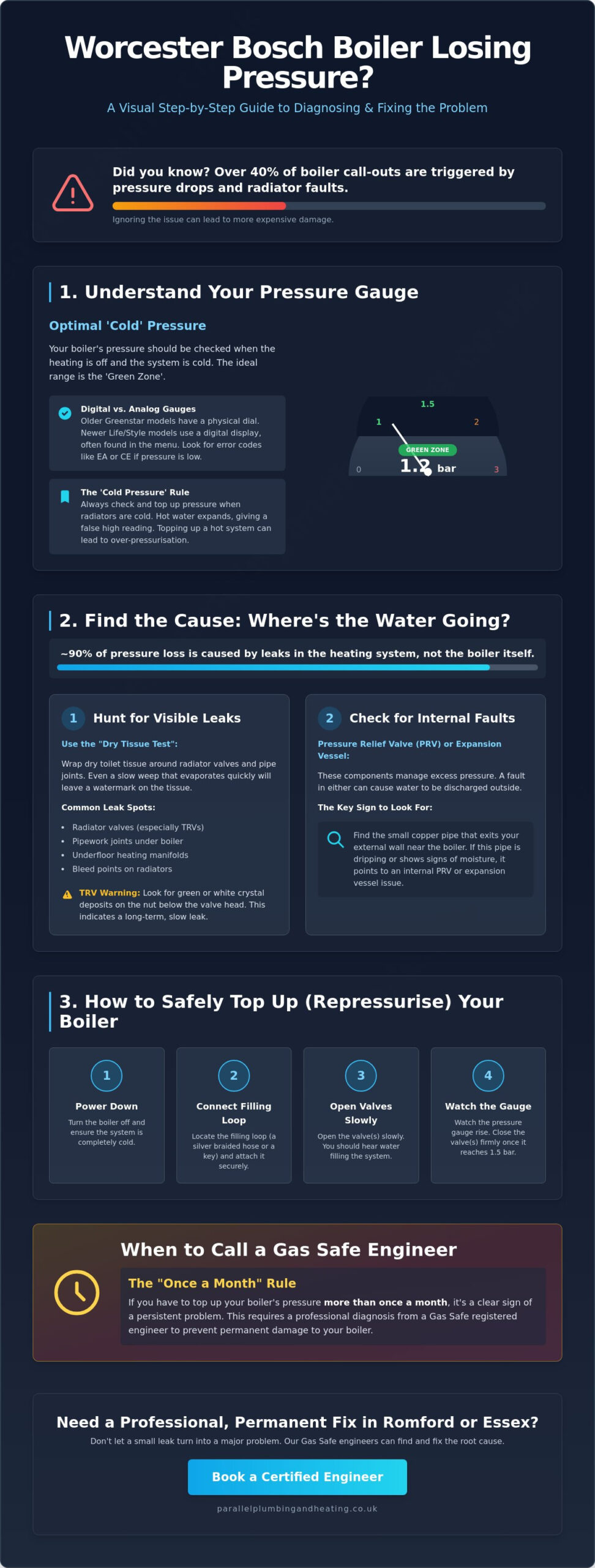
Locating the gauge depends on the age of your unit. On classic Greenstar i or CDi models, you will find a small circular dial on the front control panel. The newer Greenstar 8000 Life and Style models often hide this information behind a sleek touch-screen display or a digital menu. Regardless of the model, you are looking for the ‘Green Zone’. For optimal performance, your boiler should sit between 1.0 and 1.5 bar. It is normal for this reading to fluctuate slightly. When the heating is on, the water expands and the pressure rises. When the system cools, the pressure returns to its baseline. This movement is healthy as long as the needle stays within the designated safety limits.
Digital vs. Analog Gauges: How to Read Them
Older Worcester models use a physical needle gauge. If the needle sits below the 1.0 mark, your system lacks the water needed to operate. Newer boilers feature digital displays where you must navigate the menu using the ‘info’ or ‘reset’ buttons to find the bar reading. Keep an eye out for a flashing blue light or specific error codes like EA or CE. These signals often indicate that the system has shut down because it cannot detect enough water. Identifying these warnings early is the first step toward a worcester bosch boiler losing pressure fix before your home gets cold.
The ‘Cold Pressure’ Rule
You must always check and top up your boiler when the system is stone cold. Heat causes water to expand, which temporarily inflates the pressure reading on your gauge. If you attempt to adjust the pressure while the radiators are hot, you won’t get an accurate baseline. This often leads to over-pressurising the system. Once the water cools down, an overfilled boiler can put immense strain on your seals and joints. Always wait at least one hour after the heating has been turned off before checking the gauge or opening the filling loop.
Step 1: Hunting for Visible Leaks in Your Heating System
Most homeowners assume a drop in pressure means the boiler is broken. In reality, approximately 90% of pressure loss cases are caused by external leaks within the wider heating circuit rather than the unit itself. Your Worcester Bosch is a highly sensitive machine. Even a tiny pinhole leak in a single radiator can cause a total system shutdown as the water volume decreases. Before you assume you need a complex worcester bosch boiler losing pressure fix, you should conduct a thorough inspection of every visible pipe and joint in your home.
The “Dry Tissue Test” is the most effective way to find slow-weeping leaks that evaporate before they hit the floor. Take a piece of dry toilet tissue and wrap it around every radiator valve, joint, and union in your house. If the paper comes away damp or shows a watermark, you’ve found your culprit. In Essex homes, we often find that underfloor heating manifolds are the hidden source of trouble. These systems contain numerous connection points that can loosen over time due to natural thermal expansion and contraction. While these components are built to high standards, they must still comply with UK safety regulations regarding pressure equipment to ensure the system remains sealed and safe.
Checking Radiator Valves and TRVs
Pay close attention to your Thermostatic Radiator Valves (TRVs). Inspect the “gland nut” located just beneath the plastic dial. If you see green or white crystalline deposits, water has been slowly escaping and drying out. This is a classic sign of a failing seal. You might be tempted to grab a spanner and tighten the nut as hard as possible, but be careful. Tightening a nut too far can crush the internal washer or strip the thread, turning a minor weep into a major flood. If a gentle turn doesn’t stop the moisture, it’s time to consider a professional boiler repair to replace the faulty component properly.
Hidden Leaks and Floorboards
Not every leak is easy to spot. In older London properties, pipework is often buried deep beneath floorboards or embedded directly into concrete screed. Look for subtle clues like warped laminate flooring, damp patches on ceilings, or a musty smell in specific rooms. If your pressure drops but the “Dry Tissue Test” fails to find a leak, the issue might be sub-floor. Professional engineers use thermal imaging cameras or leak detection dyes to see through surfaces without tearing up your home. Finding these hidden issues early prevents structural damage and provides a permanent worcester bosch boiler losing pressure fix.
Step 2: Troubleshooting Internal Boiler Faults (PRVs & Vessels)
If your “Dry Tissue Test” from the previous section came back clear, the issue likely sits behind the boiler’s front cover. Two internal components usually cause a sudden drop in pressure: the expansion vessel and the pressure relief valve (PRV). These parts work together to manage the physical expansion of water as it heats up. When one fails, the other is forced into action, leading to a cycle of pressure loss that requires a specific worcester bosch boiler losing pressure fix. Understanding this relationship is the key to stopping the “top-up” cycle for good.
The expansion vessel acts like a small internal balloon. It contains a rubber diaphragm with air on one side and heating water on the other. As water heats and expands, it pushes against the air, which compresses to absorb the extra volume. If this vessel loses its air charge or the diaphragm splits, the expanding water has nowhere to go. This causes the pressure on your gauge to skyrocket toward 3.0 bar the moment your heating comes on. To prevent the boiler from exploding, the PRV opens and vents that excess water through a copper pipe to the outside of your house. Once the system cools down, the pressure drops to zero because that water is now gone.
The Copper Pipe Test
You can verify this internal fault without even touching a tool. Locate the small copper “blow-off” pipe on the external wall behind your boiler. It usually has a 90-degree bend facing back toward the brickwork. Tie a small plastic sandwich bag over the end of this pipe using a rubber band. Run your central heating for an hour. If the bag collects water, your PRV is discharging. This confirms that either the valve itself is faulty or your expansion vessel has failed. A dry pipe means the leak is definitely elsewhere in your home’s pipework.
Expansion Vessel Recharge vs. Replacement
In hard water areas like Romford and across Essex, limescale can accelerate the wear on internal components. If your expansion vessel has simply lost its air pressure, a professional can often “recharge” it using a specialized pump and gauge. However, if the internal rubber membrane has perished, the entire vessel must be replaced. You should never attempt to open the boiler casing or pump up the vessel yourself. This work involves high-pressure components and gas-path seals. It is a task that must be handled by an engineer to ensure your system remains compliant with safety standards. Finding a permanent worcester bosch boiler losing pressure fix often involves checking the heat exchanger as well, as a partial blockage can mimic these pressure symptoms by causing localized overheating.
How to Top Up Worcester Bosch Boiler Pressure Safely
Before you attempt any adjustment, ensure your boiler is switched off and the system is stone cold. As we discussed in the first section, checking a hot system gives a false reading due to water expansion. Topping up is often the immediate worcester bosch boiler losing pressure fix required to get your heating back online, but it must be done with precision. Your target is 1.5 bar on the gauge. Never fill it to the very top of the green zone; your system needs that extra “headroom” to allow for water expansion once the boiler starts firing again.
If you accidentally over-pressurise the system and the needle climbs toward 3.0 bar, don’t panic. You can lower the pressure by bleeding a single radiator. Use a radiator key to release a small amount of water into a bowl until the gauge drops back into the safe 1.0 to 1.5 bar range. If you find yourself needing to do this frequently, you may require professional boiler repairs to investigate a faulty filling valve or expansion issue.
Using the Worcester Internal Filling Key
Many Worcester Bosch Greenstar models feature an internal filling link. Look at the underside of your boiler for a white plastic tray. Inside, you will find a shaped plastic “key.” Remove the key and look for the manifold port nearby. You must insert the key firmly, turn it to the locked position, and then turn the white plastic nut next to it to start the water flow. Always ensure the key is fully engaged before turning. If the key isn’t locked properly, it can spray water or fail to open the valve. Remember to remove the key and place it back in its tray once you hit 1.5 bar to prevent the system from overfilling if a seal fails.
External Filling Loops (Braided Hoses)
If your boiler doesn’t have an internal key, you likely have an external filling loop. This is a silver braided hose connected between two pipes, usually located directly beneath the boiler or in a nearby airing cupboard. To top up the system:
- Ensure both ends of the hose are tightly screwed onto the valves.
- Slowly open the two black-handled valves. You should hear a distinct ‘hiss’ as mains water enters the heating circuit.
- Watch the gauge closely. The needle will move faster than you expect.
- Close both valves tightly as soon as the needle reaches 1.5 bar.
Once finished, it is best practice to disconnect the braided hose. This is a safety requirement that prevents accidental over-pressurisation if one of the valves develops a slow leak. This ensures your system remains closed and prevents unnecessary strain on the internal components.
When to Call a Gas Safe Engineer in Romford or Essex
Topping up your system is a simple DIY task, but you must know where the limit lies for your own safety. It’s illegal for anyone not on the Gas Safe Register to remove the boiler casing. This cover isn’t just an aesthetic panel; it acts as a critical seal for the combustion chamber. Tampering with internal components risks gas leaks or carbon monoxide exposure. If the visual checks in the previous sections didn’t provide a worcester bosch boiler losing pressure fix, the fault is likely internal and requires a professional touch.
Follow the “Once a Month” rule to protect your heating system. If you find yourself reaching for the filling loop more than once every four weeks, you aren’t fixing the problem; you’re just masking a symptom. Constant pressure loss indicates a persistent leak or a failing expansion vessel that will eventually lead to a total boiler lockout. Addressing these issues early prevents a minor weep from turning into a major flood that damages your electrics and flooring.
The Danger of Recurring Pressure Loss
Every time you add fresh water to your heating circuit, you introduce oxygen and minerals. In Romford and across Essex, our hard water is particularly aggressive toward internal components. This fresh oxygen reacts with the metal inside your radiators to create iron oxide, better known as black sludge. This thick debris settles in the bottom of radiators and blocks the narrow channels of your heat exchanger. This leads to localized overheating and sudden pressure spikes that force the boiler to vent water.
Topping up also dilutes the protective chemical inhibitor that circulates in your pipes. Without this inhibitor, internal corrosion accelerates rapidly. If your radiators have cold spots at the bottom or your boiler makes a kettling noise, Power Flushing is often the only way to restore efficiency and stabilize your pressure. This process cleans the entire system, removing the sludge that causes your Worcester Bosch to struggle.
Emergency Repairs in London and Essex
When your heating fails on a cold night, you need a local expert who understands the specific quirks of the Worcester Bosch Greenstar range. Parallel Plumbing and Heating Ltd provides 24/7 availability for emergency boiler failures throughout Romford and the surrounding areas. We take pride in our punctuality and our commitment to transparent pricing for all boiler repairs. You won’t face hidden fees or high-pressure sales tactics when we visit your home.
Choosing a regional specialist ensures faster parts sourcing. Because we work in your neighborhoods every day, we carry common Worcester Bosch components like pressure relief valves and filling keys on our vans. This often allows us to provide a worcester bosch boiler losing pressure fix during the very first visit. Beyond emergency repairs, we strongly recommend booking an annual boiler service. This proactive check allows us to test the expansion vessel’s charge and inspect all seals, catching pressure-related faults before they leave you without hot water.
Get Your Heating Back on Track Today
You now have the tools to differentiate between a simple radiator weep and a more complex internal fault like a failed expansion vessel. While mastering the filling loop is a vital skill for any homeowner, remember that a permanent worcester bosch boiler losing pressure fix requires addressing the root cause. Constantly adding fresh water only accelerates internal corrosion and leads to expensive sludge build-up over time. It’s better to act now than to wait for a total system failure when the weather turns cold.
If your pressure continues to drop despite your best efforts, don’t risk your safety or your warranty by opening the boiler casing yourself. Our Gas Safe Registered Engineers provide the expert care your system needs to stay efficient. We offer fixed-price repair quotes and an up to 3-year workmanship guarantee to give you total peace of mind during a stressful breakdown. Book an Expert Worcester Bosch Repair in Romford & Essex today and let us restore your home’s warmth with our dependable local service. We are ready to help you keep your family warm and safe.
Frequently Asked Questions
Is it normal for a Worcester Bosch boiler to lose pressure over time?
It is normal for a boiler to lose a tiny amount of pressure over a year, but you shouldn’t need to top it up more than once or twice. Frequent drops suggest a leak in your pipework or a failing internal component. If you find yourself searching for a worcester bosch boiler losing pressure fix every few weeks, your system has a fault that requires professional attention to prevent long-term damage.
Can I still use my hot water if the boiler pressure is low?
Most modern Worcester Bosch boilers will shut down completely if the pressure drops below 0.5 bar. This safety lockout prevents the heat exchanger from overheating without sufficient water. You won’t have access to heating or hot water until the system is safely repressurised. This mechanism protects your boiler’s internal parts from irreversible thermal stress and potential failure during operation.
How much does it cost to fix a boiler losing pressure in London?
Gas Safe engineer call-out fees in London and the South East typically range between £80 and £150 for standard appointments in 2026. Emergency fees can be significantly higher, often exceeding £220. These rates cover the initial diagnosis and labour. The final cost depends on whether you need simple seals replaced or a major component like a new expansion vessel or heat exchanger to resolve the issue.
Why does my boiler pressure go up when the heating is on?
Pressure naturally rises when the water in your system heats up and expands. A small increase of 0.3 to 0.5 bar is expected and healthy. However, if the needle swings into the red zone or hits 3.0 bar, your expansion vessel has likely failed or lost its air charge. This requires a professional to recharge or replace the vessel to ensure the system can manage thermal expansion safely.
What is the EA fault code on a Worcester Bosch boiler?
The EA fault code signifies a “flame detection” failure. While it often relates to gas supply or ignition leads, low system pressure can also trigger this lockout on certain models. If you see this code alongside a low pressure reading, repressurising the system may clear the fault. If the code persists after you’ve topped up, a Gas Safe engineer must inspect the gas valve and electrodes.
Can a leaking radiator cause my boiler to lose pressure?
Yes, even a tiny “weeping” leak from a radiator valve or a pinhole in the radiator body will cause pressure loss. Because heating water is under pressure, even a small exit point allows water to escape steadily. These leaks often evaporate on hot radiators, making them hard to spot. Using a worcester bosch boiler losing pressure fix like the dry tissue test is the best way to find them.
Do I need a new boiler if the pressure keeps dropping?
You rarely need a completely new boiler just because of pressure issues. Most causes, such as faulty valves, leaking joints, or failed expansion vessels, are standard repairs for a qualified engineer. However, if your boiler is over 15 years old and the heat exchanger is leaking internally, a replacement might be more cost-effective than an expensive, complex repair that may only provide a temporary solution.
How do I bleed my radiators to lower the boiler pressure?
To lower high pressure, use a radiator key to “bleed” water from a radiator. Place a bowl under the bleed valve and turn the key slowly until water, not just air, starts to flow. Monitor your boiler’s pressure gauge as you do this. Stop once the needle returns to the 1.5 bar mark. This is the safest way to remove excess water from an over-pressurised system without touching the boiler.