

Last Tuesday, a homeowner in a Victorian terrace in Greenwich realised their oversized boiler was the direct cause of a 15% spike in their monthly energy bills. It is a common mistake. Many people assume a bigger unit automatically means better performance, but in reality, an incorrectly specified boiler often leads to “short-cycling” and wasted cash. You want a warm home and a powerful shower without paying for energy you never use.
We agree that the technical jargon around kW ratings and flow rates is confusing. That is why this 2026 guide simplifies the process of discovering exactly what size boiler do i need for your London or Essex property. We will show you how to calculate the right output based on your radiator count and specific hot water demands. You will also learn if your existing 15mm gas pipework needs an upgrade to handle a modern, high-efficiency system. We have designed this breakdown to give you the facts required to book a professional site survey with total confidence.
Key Takeaways
- Understand that boiler “size” refers to power output in kilowatts (kW) rather than physical dimensions, helping you avoid overpaying for wasted energy.
- Discover how to accurately calculate what size boiler do i need based on your radiator count and the specific hot water demands of your London or Essex property.
- Learn why local factors like Victorian ceiling heights and gas pipe diameters are critical to choosing a system that operates at peak efficiency.
- Prepare for your installation with our 2026 checklist, covering everything from boiler types to the essential infrastructure checks required for a seamless upgrade.
- Find out why a professional site survey from a Gas Safe registered engineer provides a more reliable and efficient solution than generic online sizing tools.
What “Boiler Size” Actually Means (and Why It Matters in London)
When you start asking what size boiler do i need for your home, don’t look for a tape measure. In the heating industry, “size” refers to the power output measured in kilowatts (kW), not the physical space the unit takes up on your kitchen wall. kW output is the maximum energy a boiler uses to heat water at any given moment. Getting this number right is the difference between a cosy home and a massive energy bill.
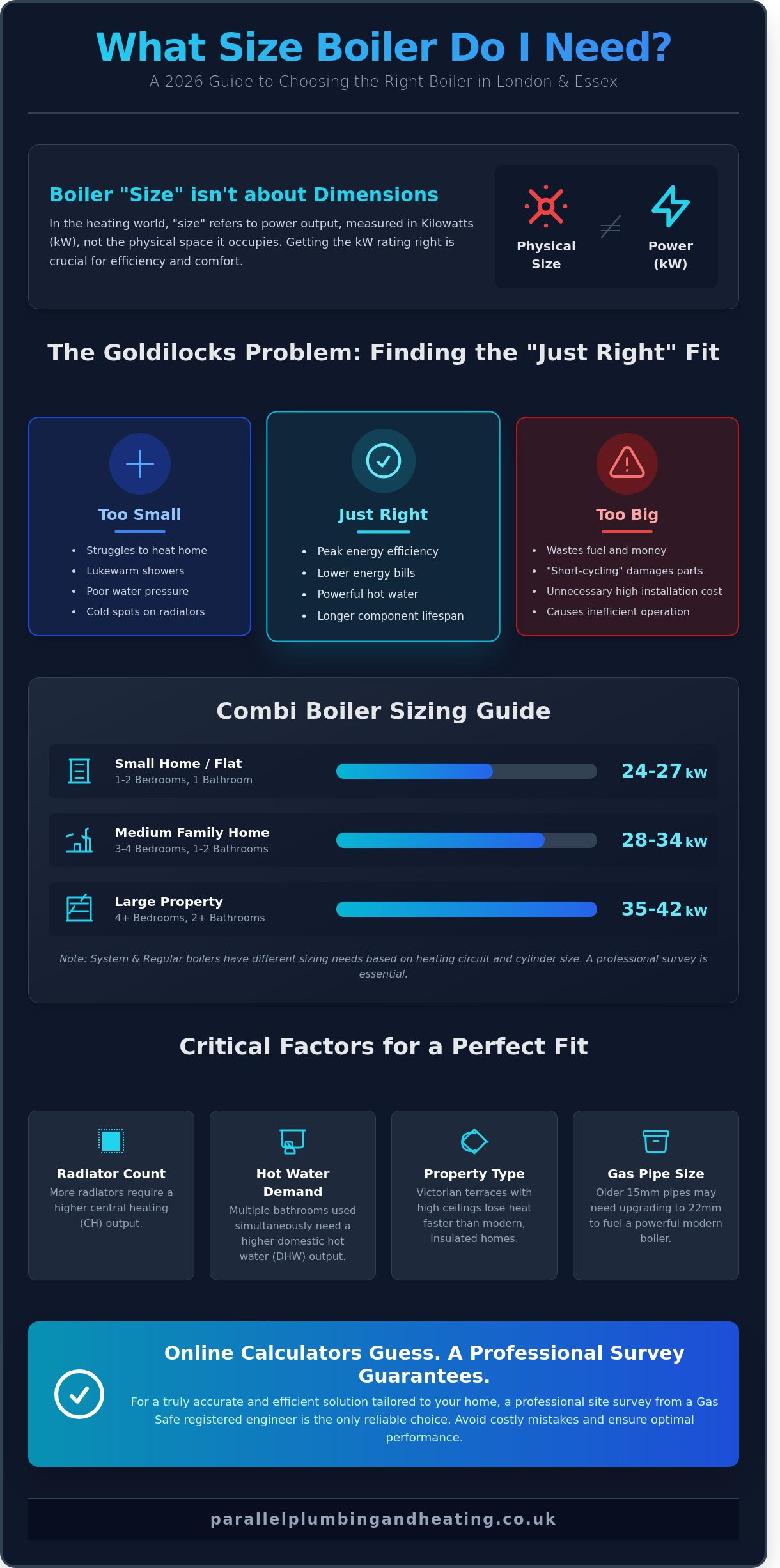
London and Essex homeowners face a unique “Goldilocks” challenge. If your boiler is too small, your radiators won’t get hot enough and your shower will run cold. If it’s too large, the system becomes incredibly inefficient. With 2026 energy prices set to remain a significant household expense, an oversized boiler is a luxury no one can afford. You need a unit that’s “just right” for your specific property type, whether it’s a Victorian terrace in Leyton or a modern detached house in Brentwood.
You also need to distinguish between central heating (CH) output and domestic hot water (DHW) output. Most combi boilers prioritize hot water, meaning they need a higher kW rating to heat a shower instantly than they do to keep your radiators warm. Understanding what size boiler do i need requires balancing these two distinct demands.
Understanding Kilowatts (kW) in Plain English
Think of kilowatts like a car’s horsepower. A higher kW rating means the boiler has more “grunt” to heat water quickly. However, a bigger engine isn’t always better for city driving. Modern 2026 boiler technology is far more advanced than the systems installed 15 years ago. You might find that a new 24kW boiler performs better than your old 30kW model because of a feature called modulation.
Modulation allows the boiler to reduce its output when the demand is low. Instead of running at 100% power all the time, it can “throttle down” to 10% or 20% of its capacity. This adaptability is crucial for maintaining high condensing boiler efficiency. It ensures the unit only uses the exact amount of gas required to keep your rooms at the temperature set on your thermostat.
The Risks of Choosing the Wrong Capacity
Picking the wrong capacity leads to two major problems. The first is short-cycling. This happens when an oversized boiler heats up the water too fast, realizes it’s reached the target temperature, and shuts off. It then cools down and fires up again minutes later. This constant on-off cycle wears out internal components and burns through gas needlessly.
- Component Wear: Short-cycling puts immense strain on the fan and gas valve.
- Poor Flow Rates: An undersized combi boiler won’t provide enough hot water for two people to shower at once.
- Cold Spots: If the CH output is too low, the radiators furthest from the boiler will never reach full temperature.
In a multi-bathroom home in Essex, a small boiler will ruin your morning routine. You’ll experience a significant drop in water pressure or temperature the moment someone else turns on a tap. We ensure your system is sized to handle your peak demand without wasting a penny on your standing charges.
Sizing by Boiler Type: Combi, System, and Regular
Choosing the right capacity depends entirely on how your home handles hot water. When homeowners ask what size boiler do i need, the answer changes based on whether the unit heats water instantly or stores it in a tank. Combi boilers require significantly higher kilowatt (kW) ratings than system or regular boilers. This is because a combi must generate heat on demand the second a tap opens. If the rating is too low, you’ll experience lukewarm showers and poor flow rates.
Matching the boiler type to your property style is a core part of any boiler installation essex. Older properties in South East London often retain traditional regular boilers, while modern conversions in Romford favour space-saving combis. The presence of a hot water cylinder is the deciding factor. If you have a cylinder, your boiler’s kW rating focuses mostly on the heating circuit rather than the instantaneous hot water demand. If you want a deeper understanding of how each option works before committing to a size, our guide to the types of boiler available to London and Essex homeowners in 2026 explains the key differences between combi, system, and regular units in plain English.
Combi Boiler Sizing for Flats and Houses
Combi boilers are sized by their domestic hot water (DHW) output. For a 1 to 2 bedroom flat or a small house with one bathroom, a 24kW to 27kW unit is the standard. It provides sufficient flow for a single shower. Larger 3 to 4 bedroom family homes in areas like Peckham usually require 28kW to 34kW to manage higher demand. If you live in a large property with multiple bathrooms and high-pressure showers, a 35kW to 42kW model is necessary to prevent temperature drops when two taps run simultaneously.
System and Regular (Heat Only) Boiler Sizing
System and regular boilers typically range between 12kW and 30kW. They appear smaller in power than combis, but this is because they heat a cylinder of water over a longer period. The efficiency of these systems relies heavily on the quality of the cylinder insulation. For large Essex estates with 5 or more bedrooms and traditional plumbing, a 25kW to 30kW boiler is often the most reliable choice. These units can heat large radiator circuits without the stress of providing instant hot water. If you’re unsure about your current setup, our Gas Safe registered engineers can provide a professional home assessment to confirm your requirements.
Factors Beyond Square Footage: Radiators and Local Pressure
Square footage gives us a baseline, but it rarely tells the whole story. To answer what size boiler do i need accurately, we must look at the specific heat emitters and the local infrastructure of your London or Essex borough. Every radiator acts as a heat sink. If your boiler output doesn’t match the total demand of these units, your home will never reach a comfortable temperature during a cold snap.
Local geography also plays a massive role. We often see homeowners in Southwark and Greenwich struggle with combi boiler performance because they ignored local water pressure. A 35kW boiler cannot deliver its full potential if the mains flow into the property is restricted. Our Gas Safe registered engineers always check your dynamic pressure before recommending a specific unit size.
Counting Your Radiators and Towel Rails
The most reliable shortcut for heating engineers is the radiator count. For a standard modern radiator, we typically allocate 1.5kW to 2kW of power. If you have a three-bedroom house in Essex with ten radiators, you require approximately 15kW to 20kW just for space heating. This requirement changes if you have installed large designer radiators or towel rails, which often have higher surface areas and greater heat demands.
If you have modernised your home with Underfloor Heating Installation, your boiler demand profile shifts. Underfloor systems run at lower temperatures but require consistent energy over longer periods. We factor these circuits in as high-demand zones to ensure your boiler doesn’t “cycle” or switch on and off too frequently, which wastes gas and shortens the unit’s lifespan.
Property Age and Heat Loss
Insulation levels in 2026 are the single biggest variable in boiler sizing. A 1930s semi-detached house in Romford with original solid walls loses heat roughly 45% faster than a modern apartment in Wapping. When we calculate what size boiler do i need for older properties, we often suggest slightly higher outputs to compensate for this rapid heat loss.
- Ceiling Heights: Victorian and Edwardian homes in Dulwich often feature ceilings over 3 metres high. This increases the volume of air that needs heating by 20% compared to standard 2.4-metre modern ceilings.
- Draught Points: Older properties with original sash windows or suspended timber floors require more “headroom” in boiler power to maintain steady temperatures.
- Glazing: Houses with extensive bifold doors or large glass extensions need a dedicated heat loss calculation, as glass is significantly less efficient than a cavity-insulated wall.
We don’t believe in guesswork. Our team looks at the age of your bricks, the depth of your loft insulation, and the quality of your glazing. This professional approach ensures you don’t pay for a massive boiler you don’t need, or end up with a small unit that leaves you shivering in January.
A 2026 Checklist for Sizing Your New Boiler
Determining what size boiler do i need involves more than a quick look at your old unit. Modern efficiency standards and changing UK energy regulations mean your 2026 installation must be precise. An oversized boiler wastes fuel through “short-cycling,” while an undersized one will leave your radiators lukewarm during a London cold snap. Use this checklist to gather the right data before your engineer arrives.
- Count your outlets: List every radiator, towel rail, and hot water tap in the property.
- Measure your gas pipe: Look at the copper pipe entering your current boiler. If it’s 15mm, you may need an upgrade to 22mm to support high-kW combi boilers. Modern 30kW or 35kW units require a higher volume of gas to deliver those impressive flow rates.
- Check your mains pressure: Find your internal stopcock and see if the flow feels weak. A high-output combi is useless if your local water main can’t provide at least 10 to 12 litres per minute.
- Monitor peak demand: Note if your household frequently uses two showers at the same time, such as during the 7 AM school run.
Preparing for Your Professional Survey
A successful installation starts with a clear understanding of your home’s infrastructure. Locate your stopcock and ensure it’s easy to access; we’ll need to test your incoming mains pressure here. You should also review our boiler installation Romford guide to see how local water conditions in Essex affect component longevity. Having your service history or current gas bills ready helps us understand your historical energy use. This data allows us to refine our calculations and ensure you aren’t paying for capacity you don’t use.
Future-Proofing Your Heating System
Don’t just size for today. If you plan a loft conversion or an en-suite addition within the next 5 years, tell your engineer now. Adding two new radiators and a shower can push a “perfectly sized” 24kW boiler beyond its limits. We also recommend installing smart thermostatic radiator valves (TRVs). These devices allow the boiler to modulate its output effectively, managing the load room by room rather than heating the whole house unnecessarily. If you’re considering a hybrid setup, we’ll size the boiler to work at lower flow temperatures alongside a future heat pump. “A Gas Safe engineer will use a Whole House Heat Loss Calculation to ensure your 2026 boiler is perfectly sized for peak efficiency.”
Ready to get an accurate assessment for your home? Contact our expert team to book your professional survey.
Why a Professional Site Survey Beats an Online Calculator
Generic online calculators are a useful starting point, but they rely on basic algorithms that often lead to inefficient outcomes. These tools usually default to the “safest” option, which frequently results in oversizing your new unit. When you ask what size boiler do i need, an algorithm might suggest a 30kW model for a home that only requires 24kW. This leads to “short-cycling,” where the boiler switches on and off rapidly, wasting gas and wearing out internal components prematurely.
Parallel Plumbing and Heating Ltd takes a more technical approach. During a local survey in London or Essex, our Gas Safe engineers look for factors a computer misses. We check wall thickness, loft insulation levels, and window efficiency. Most importantly, we look for hidden system issues. Magnetite sludge build-up in radiators often mimics the symptoms of an undersized boiler by creating cold spots. We identify these problems early, ensuring you don’t pay for a larger boiler when a system power flush is the actual solution. Our commitment to transparency means we provide a clear plan with no hidden costs.
The Parallel Plumbing Approach in South East London
Our engineers possess deep expertise in the specific housing stock found across Deptford, Bermondsey, and Camberwell. We understand the unique heating challenges of Victorian conversions and modern apartment blocks alike. We act as a “safe pair of hands” for local landlords, ensuring every installation meets strict safety certifications while being perfectly sized for the property. To give you total peace of mind, we guarantee our workmanship for up to three years. You can trust that the job is done right the first time.
Get a Fixed-Price Quote Today
We provide fixed-price installation fees for budget-conscious Essex families, so you know exactly what you’re paying before we start work. If your current system has failed completely, our team is available for 24/7 call-outs to restore your heating and hot water immediately. Don’t rely on a guess when it comes to your home comfort and energy bills. Contact our Gas Safe engineers for an accurate boiler sizing survey to find out exactly what size boiler do i need for your specific property.
Get Your Heating Right for 2026
Choosing the right kilowatt output ensures your heating system runs efficiently without wasting energy or leaving your family in the cold. While online tools offer a quick estimate, they often overlook critical local factors like the specific water pressure in Essex or the heat loss common in older London properties. Accurate sizing depends on your total radiator count and peak hot water demand rather than just square footage. If you’re still wondering what size boiler do i need to future-proof your home, the most reliable step is a professional site visit.
Our Gas Safe Registered engineers have delivered expert local service across London and Essex since 2018. We understand the regional property types and provide a transparent approach with no hidden costs. Every installation we perform comes with up to a 3-year workmanship guarantee, so you can trust that your new system is built to last. Don’t leave your home’s comfort to a generic calculator when you can have a tailored solution from a local expert.
Book your expert boiler sizing survey with Parallel Plumbing & Heating Ltd today
We look forward to helping you stay warm and efficient all year round.
Frequently Asked Questions
Can a boiler be too powerful for my house?
Yes, an oversized boiler leads to “short cycling,” where the unit turns on and off too frequently. This reduces efficiency by up to 15% and increases wear on internal components like the heat exchanger. Modern modulating boilers can adjust their output, but choosing a 40kW unit for a small flat remains wasteful. Our Gas Safe registered engineers ensure your system matches your home’s heat loss calculations exactly.
What size combi boiler do I need for a 3-bedroom house with a power shower?
You typically need a 30kW to 35kW combi boiler to handle the hot water demands of a 3-bedroom home with a power shower. While heating a 3-bed house only requires about 12kW to 15kW, the “what size boiler do i need” question depends heavily on hot water flow rates. A 30kW model delivers roughly 12.3 litres of hot water per minute, which is the minimum for a satisfying shower experience.
Is a 24kW boiler big enough for a 4-bedroom house?
A 24kW boiler is usually too small for a 4-bedroom house, especially if it’s a combi model serving multiple bathrooms. While 24kW might heat the radiators in a well-insulated 4-bed home, it won’t provide enough hot water for two showers running simultaneously. For a property this size, we recommend a 35kW or 40kW combi, or a 24kW system boiler paired with a 200-litre unvented cylinder.
How many radiators can a 30kW combi boiler run efficiently?
A 30kW combi boiler can efficiently run up to 15 radiators in a standard London or Essex home. Most 30kW units provide about 24kW of power for the heating circuit, which is plenty for medium-sized properties. If your home has more than 15 radiators or significant heat loss through older single-glazed windows, a 35kW unit offers a more reliable solution for those cold January nights.
Do I need a bigger boiler if I have high ceilings in my London home?
Yes, high ceilings increase the total volume of air your system must heat, requiring a higher kW output. Victorian properties in London often have 3-metre ceilings, which represent 20% more space to heat than modern 2.4-metre rooms. We calculate the exact cubic meterage of every room to ensure your new boiler overcomes this extra volume without wasting gas or leaving you in the cold.
What happens if I install a boiler that is too small for my property?
An undersized boiler will struggle to reach your desired thermostat temperature, leaving your home cold during peak winter. It will run constantly at maximum capacity, which shortens the lifespan of the unit and increases your energy bills. You’ll also notice a drop in hot water pressure if someone opens a second tap while you’re in the shower, leading to frustrating temperature fluctuations.
Does a bigger boiler use more gas than a smaller one?
A bigger boiler doesn’t necessarily use more gas if it’s a modern condensing model with a high turndown ratio. These units modulate their power down to as low as 3kW when demand is low. However, if the boiler is massively oversized and lacks modulation, it will cycle and waste fuel. Accurate sizing ensures you only pay for the gas you actually need to stay warm and comfortable.
Should I size my boiler based on the number of bathrooms or bedrooms?
You should always size a combi boiler based on the number of bathrooms, as hot water demand is the most taxing task for the unit. A 1-bedroom flat with two bathrooms requires a larger combi boiler than a 3-bedroom house with just one bathroom. When asking “what size boiler do i need,” focus on how many people will use hot water at the same time to avoid cold shocks. To better understand which types of boiler suit different bathroom and bedroom configurations, our 2026 guide for London and Essex homeowners covers each option in full detail.